
 Baku 25° C
Lin O'Grady: EBRD jointly with EU working on investment program for Azerbaijan's Karabakh - INTERVIEW
- 22 May, 2026
- 15:25

Over the past thirty years, Azerbaijan has undergone a remarkable modernization process, from rebuilding its core transport infrastructure to implementing large-scale digital and environmental transformation. At a time when cities are becoming key players in the global climate agenda, the country has placed a strong emphasis on sustainable urban development and smart technologies. The European Bank for Reconstruction and Development (EBRD) is playing a strategic partner in this process, supporting Azerbaijani cities in the transition from the design stage to practical investments in environmentally friendly infrastructure.
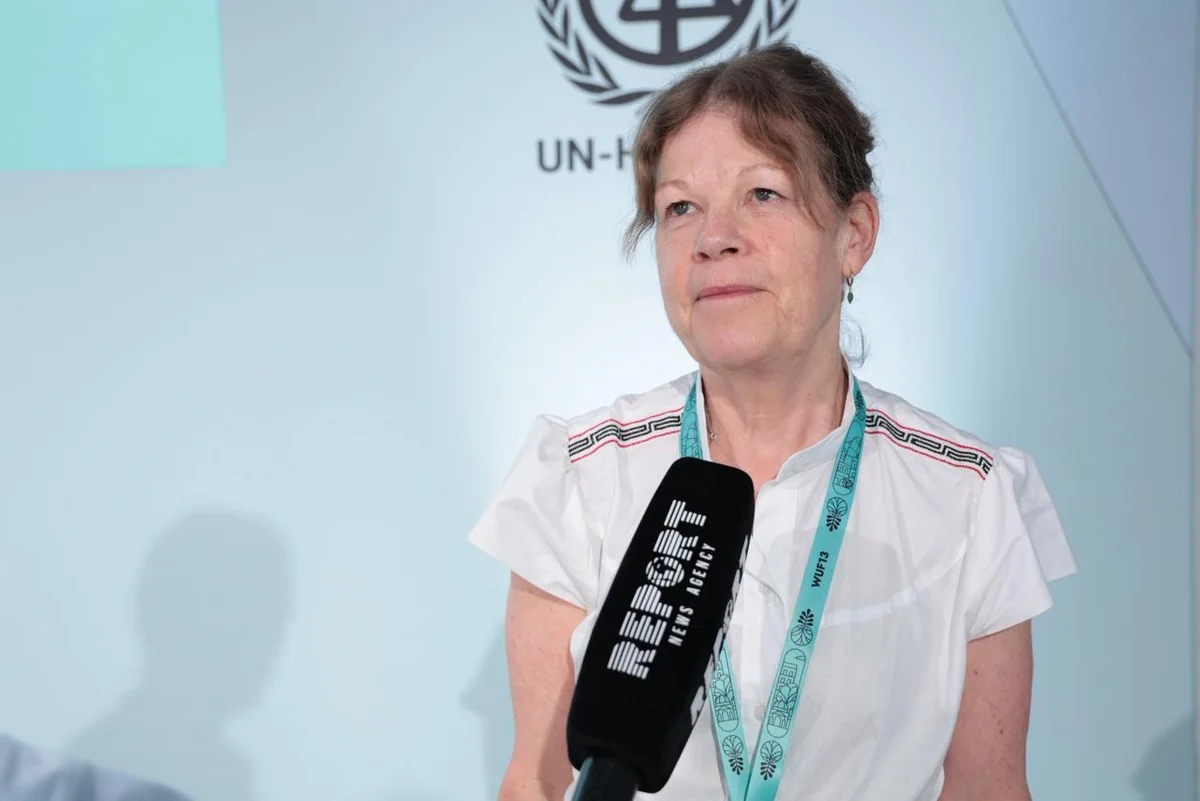
In an exclusive interview with Report, Lin O'Grady, head of Green Cities at the EBRD, discussed Baku's long-term transformation, Ganja's achievements as a flagship city of the Green Cities program, the prospects for reviving the capital's industrial areas, and the comprehensive transition to electric transport.
Report presents the interview:
- As far as I know, you worked in Azerbaijan in the 1990s. Could you share your thoughts on how the country has changed over the past 30 years?
- I first came to Azerbaijan 30 years ago. At the time, I was part of the transport team at the EBRD, focusing on the Caucasus region. We did a lot of work with the local railway and road authorities. To give you some background, the EBRD financed the upgrade of the east-west railway line with Azerbaijan Railways.
We also funded the construction of the east-west highway leading to the Black Sea ports, as well as the road connecting Baku to Astara. Having not visited for quite some time, I can see that the country has undergone a complete transformation. Baku has become a thoroughly modern city. It feels like coming to an entirely different place, yet you have beautifully managed to preserve your rich heritage.
- How has COP29 shifted the dynamics of the EBRD"s engagement with Azerbaijani cities?
- COP29 was a milestone for urban development, as cities are increasingly becoming a central focus of the climate discussion. This shift really crystallized here in Baku. On a broader scale, during COP29, we signed a Memorandum of Understanding (MoU) with the Government of Azerbaijan to support Azerbaijani cities. That initiative has truly taken off in the couple of years since the conference was held.
- The Baku Continuity Coalition for Urban Climate Action was launched during COP29. What role do EBRD Green Cities play in supporting these commitments in Baku and other cities across the country?
- One of the key themes of the Baku Coalition was the importance of multi-level governance, which focuses on the connectivity between the central government and sub-national or municipal authorities. This aligns perfectly with the EBRD's strategy. While we work closely with the central government in countries like Azerbaijan, our approach actively supports lending directly to cities at the local level. Therefore, this multi-level governance completely supports our approach to city lending.
- Ganja has already moved from the planning stage to the implementation of concrete projects. How do you assess the progress made so far, and to what extent can Ganja serve as a model for other cities in the Caucasus?
- To provide some context, the EBRD"s Green Cities program spans our entire countries of operation, now encompassing 60 cities with over €3.5 billion invested across more than 100 projects. We were delighted when Ganja joined the initiative. In many ways, Ganja is a model of how the Green Cities program is designed to work.
Developed with our support, the project was largely driven by the local administration, which successfully formulated its Green Cities Action Plan (GCAP).
Based on this roadmap for green and sustainable investments, the EBRD has financed street lighting and water infrastructure upgrades, and we are currently exploring further projects. Additionally, we have provided policy support, particularly in water management. Ganja has perfectly delivered on all three core building blocks of this flagship program.
- What are the prospects of the full-scale inclusion of the capital [Baku] into the Green Cities initiative?
- As mentioned, the MOU signed during COP29 has paved the way for deeper engagement with other Azerbaijani cities, including Shaki and Baku.
We have already begun preparing for concrete projects with Baku, focusing on water infrastructure and urban regeneration, with the latter focusing particularly on the reconfiguration of oil-polluted sites. Moving forward, we will see how our partnership with the capital develops. We remain fully open to Baku joining the EBRD Green Cities program, provided it meets the established criteria. This is an ongoing conversation that we will continue to have with the city administration.
- In addition to Ganja and Shaki, is the EBRD considering the inclusion of other cities, such as Sumgait or cities in the Karabakh region, which are currently being rebuilt with a focus on smart and green technologies?
- We will consider any city provided it meets the eligibility criteria for the Green Cities program, as mentioned above. In a nutshell, the municipality should first agree to undertake an initial green and sustainable investment with us. This can be in various sectors, including water, wastewater, transport, solid waste, energy, or housing – the central focus of discussions at WUF13.
Furthermore, the city should commit to developing a Green Cities Action Plan (GCAP). This is precisely why Ganja has been such a successful example. The GCAP is not designed for a city to invest all that time and effort just to execute a single project; there needs to be a clear intention to pursue subsequent investments. The EBRD wishes to establish a long term relationship with the City. Additionally, the city's population must be over 50,000, a threshold that most Azerbaijani cities can easily meet.
In terms of specifically Karabakh, outside of green cities, we're already working in that region with the European Union looking at how we can support former IDPs that have returned to Karabakh.
- EBRD"s new strategy highlights the role of Artificial Intelligence in managing climate shocks. Do you plan to implement digital twins or AI-driven monitoring systems in Azerbaijan?
- Ultimately, the EBRD is a demand-driven institution. We make every effort to meet our clients' specific needs, provided they align with the bank's core strategic objectives. Advanced technologies, including AI and digital transformation, are key themes both for the EBRD as a whole and within the Green Cities framework. Consequently, we may support AI integration and the development of digital twins, if requested by our partners.
- Azerbaijan is actively renewing its bus fleet. Does the Green Cities program intend to support the development of infrastructure for e-buses and micromobility in the regions, rather than just in the capital?
- E-mobility is a major area of focus for the EBRD. We firmly believe it is where we can drive significant impact in the broader energy transition, facilitating the shift away from internal combustion engine vehicles and buses. Within this region, we have already successfully financed electric bus fleets in Batumi, Samarkand, and Bishkek. The EBRD would certainly be highly interested in rolling out similar initiatives here in Azerbaijan.
Crucially, infrastructure development should go hand in hand with purchasing vehicles; you cannot simply finance the rolling stock without the supporting charging network. Therefore, our financing package would comprehensively cover the electric buses, the dedicated depots, and the necessary charging infrastructure. Furthermore, to push the boundaries of sustainability, we aim to design these depots with rooftop solar panels, where circumstances allow.
- The EBRD is helping Azerbaijan explore its low-carbon hydrogen potential. Are there any plans for projects involving hydrogen for urban transport or residential heating?
- While there are no concrete investment projects at the moment, we are actively working with Azerbaijan to deliver on the hydrogen strategy presented during COP29. Engaging in projects that focus on green hydrogen development is a strategic priority, and the bank is keen to expand its portfolio in this sector moving forward.
- As Baku prepares to host WUF13, it is becoming the premier global platform for discussing the future of cities. How does the EBRD plan to utilize this platform to showcase the successes of the Green Cities program in Azerbaijan and the wider region? Will Ganja serve as a "showcase" of achieved results for delegates from around the world?
- To reiterate my earlier point, Ganja is a prime example of how the Green Cities program operates most effectively. The city developed a comprehensive Green City Action Plan, which the bank is now supporting through a number of municipal investments alongside ongoing policy cooperation. Furthermore, our engagement with both the local administration and the relevant government authorities has been excellent. Ganja is truly being showcased as a flagship success story for the entire initiative.
Author