Baku 17° C
Business Council as new level of Baku-Berlin economic dialogue
- 21 July, 2026
- 17:42
Stay up to date with the top news!
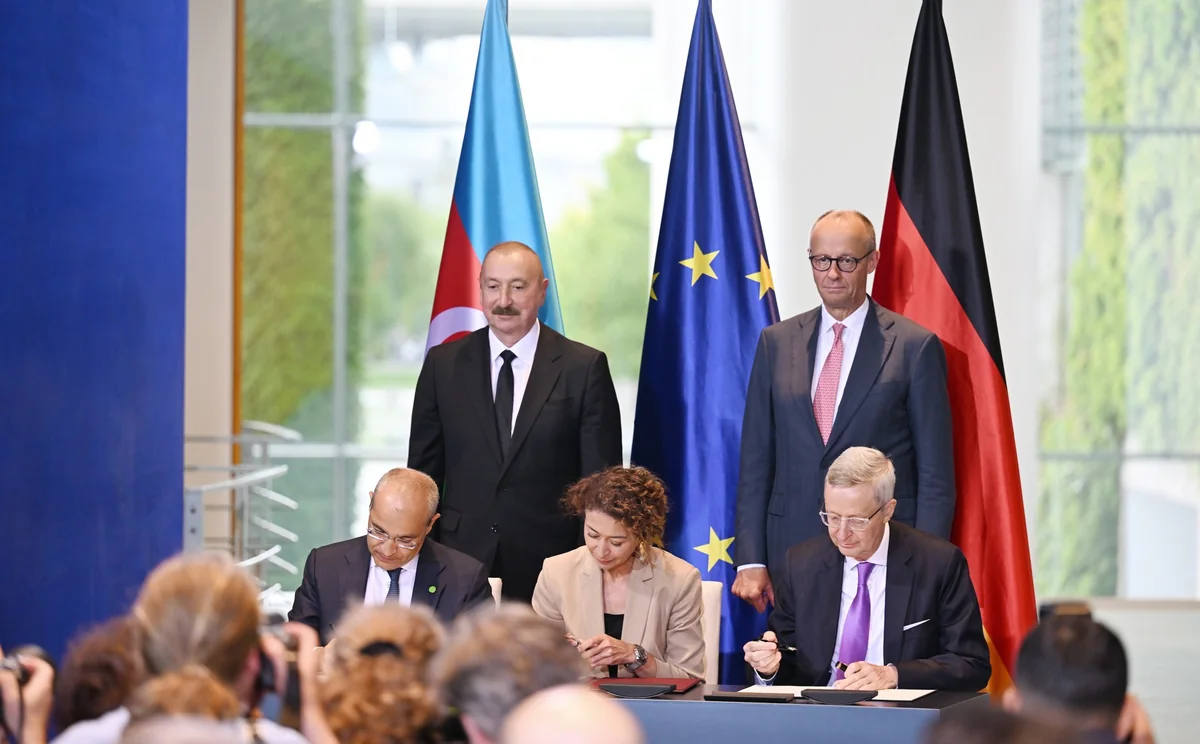
The Joint Declaration on the Establishment and Activities of the Azerbaijani-German Business Council, signed today during the visit of President of Azerbaijan Ilham Aliyev to Germany, serves as an institutional response to a specific demand for elevating economic cooperation between the two countries into a more systemic, practice-oriented, and long-term format aligned with the level of their strategic partnership.
Until now, trade and economic ties between Azerbaijan and Germany-despite their intensity-developed largely in waves centered around visits, forums, and individual deals. The Declaration lays an institutional foundation for further deepening trade, economic, and investment cooperation, establishing a permanent structure where a set of fragmented contacts operated previously.
This fundamentally alters the logic of interaction. The question shifts from "when will the next meeting take place" to "which structure handles this on a continuous basis." This structural permanence is precisely what distinguishes the Business Council from previous cooperation formats.
Direct channel between government and business
The primary function of the Business Council is to provide a permanent platform for direct dialogue between state entities and the business communities of Azerbaijan and Germany. Operational issues-ranging from regulatory barriers to project approvals-can now be addressed through routine channels without waiting for high-level state visits.
Practical developments underscore the demand for such a channel: on July 20 in Berlin, the President of Azerbaijan met with Michael Harms, Chairman of the Committee on Eastern European Economic Relations. His organization coordinates the interests of German companies operating across Eastern Europe, the Caucasus, and Central Asia.
During the meeting, both sides noted the growing interest of Azerbaijani and German entrepreneurs in joint endeavors and discussed methods to institutionalize these activities.
Discussions covered traditional and alternative energy, connectivity via the Middle Corridor, transport, logistics, the application of German agricultural technologies in Azerbaijan, and the country's tourism potential. The Business Council serves as the operational mechanism designed to resolve this exact agenda, responding directly to established commercial demand. That is, the mechanism responds to a request already formulated by the business, and is not created in isolation from it.
President Ilham Aliyev stated in Berlin that German companies are actively working in Azerbaijan. He added that more than 200 companies with German capital are currently operating in Azerbaijan. The president also expressed confidence that the talks in Berlin and the agreements reached will lead to an increase in the number of German companies in Azerbaijan.
According to the president, joint investments and specific proposals, which Baku plans to present in the near future, will further expand the presence of German businesses.
Instrument for investment and joint projects
Trade figures illustrate the current state of Azerbaijani-German economic relations. In 2025, bilateral trade turnover reached approximately $1.5 billion, while in January–June 2026, the volume stood at $572.9 million. Germany currently ranks as Azerbaijan's 7th largest foreign trade partner.
"Oil makes up the bulk of our exports to Germany. Azerbaijan supplies crude oil worth several hundred million dollars. We can supply as much as needed," Ilham Aliyev said in Berlin at a joint press conference with German Chancellor Friedrich Merz.
According to customs statistics, in 2025, Germany purchased 956,700 tons of Azerbaijani oil valued at $502 million, ranking among the top five buyers. Between January and June 2026, Germany imported 360,300 tons of oil from Azerbaijan worth $210.8 million.
However, Baku aims to advance economic cooperation and diversify trade relations-a key priority for the new Council.
The Council is initiated as an effective mechanism for promoting mutual investments, expanding business contacts, and executing new joint projects. This is particularly relevant given the existing energy foundation: Azerbaijani gas exports to Europe expanded from approximately 8 billion cubic meters prior to 2022 to 13 billion cubic meters today, with plans to reach at least 20 billion cubic meters by 2027.
President Ilham Aliyev emphasized that last year, Azerbaijan's total gas exports amounted to 25 billion cubic meters, half of which went to European Union countries.
According to him, Azerbaijan began supplying gas to Germany in 2026 under a 10-year contract with a volume of 1.5 billion cubic meters per year. Azerbaijan may increase this volume, but several conditions should be met. First, there should be an appeal to Azerbaijan. Second, the existing gas infrastructure should be expanded and, of course, the investment issue should be resolved, as European banks are reluctant to finance such projects.
Ilham Aliyev noted that it would be good if European banks reconsidered their decisions, especially given the deepening crisis in the Middle East and the ongoing Russia-Ukraine war. These are all processes with unpredictable outcomes.
Overall, Azerbaijan supplies gas to 16 countries, ten of which are EU member states.
This established base provides clear direction for the Business Council. With energy cooperation already moving beyond one-off deals, the logical next step is extending this systemic approach to investments, industrial cooperation, logistics, and the restoration of Azerbaijan's liberated territories, where interest from German investors has been recorded.
Mutual expansion in respective markets
Finally, the declaration outlines its core objective: the establishment of the Council will facilitate increased involvement of German business in economic projects in Azerbaijan, while expanding the presence of Azerbaijani companies in the German market. This symmetry reflects a two-way flow of capital, expertise, and corporate activity rather than unilateral investment attraction.
Thus, the Business Council is designed to institutionally consolidate existing practices: the growing mutual interest of both business communities-as confirmed during Ilham Aliyev's meeting with Michael Harms-and the expanding substance of cooperation currently evident in the energy domain. The logic behind its creation envisages the transfer of partnership into systemic work.
Author