 Baku 22° C
President Ilham Aliyev participated in panel discussion in Munich - UPDATED
- 15 February, 2026
- 01:16

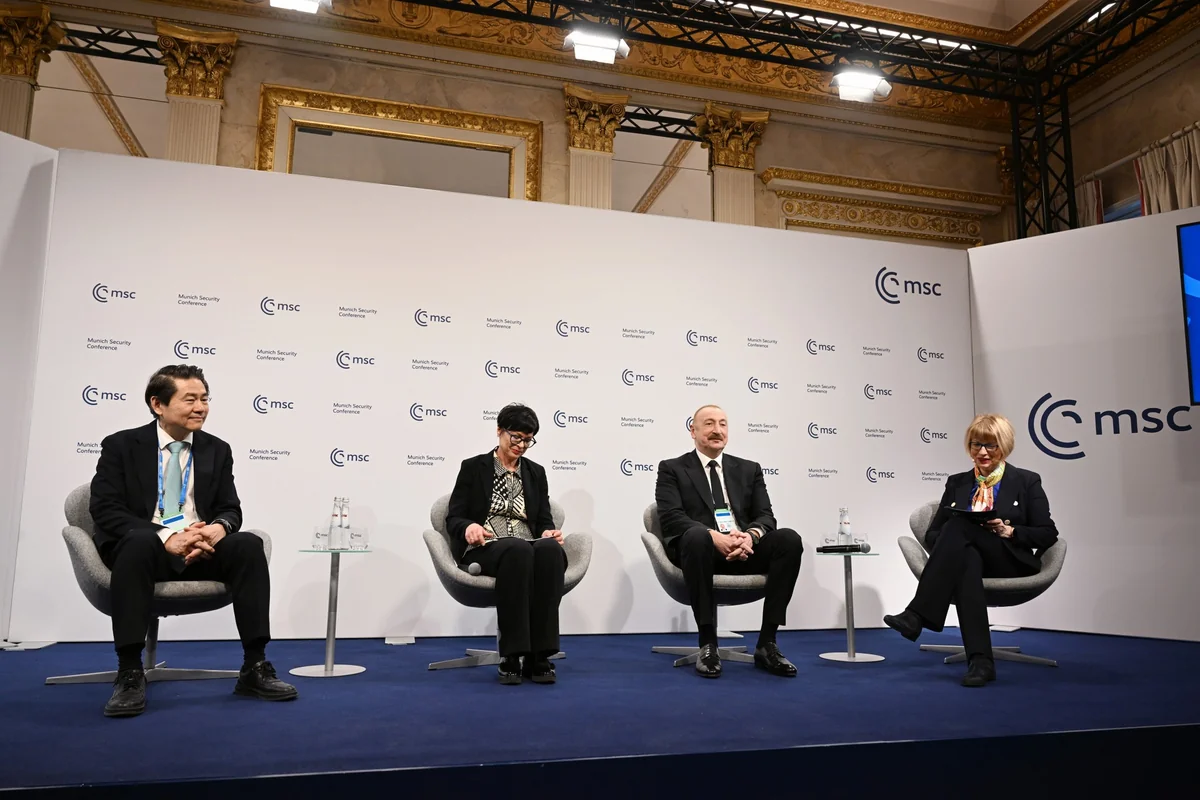
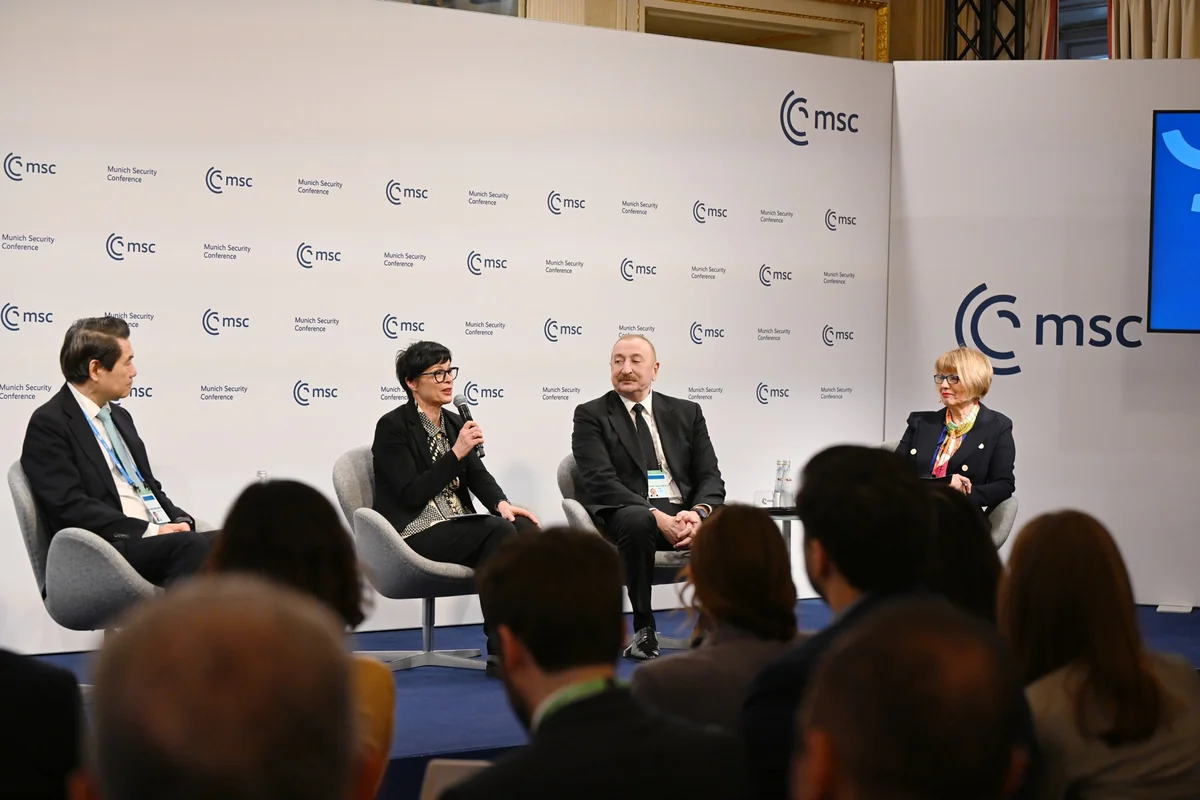
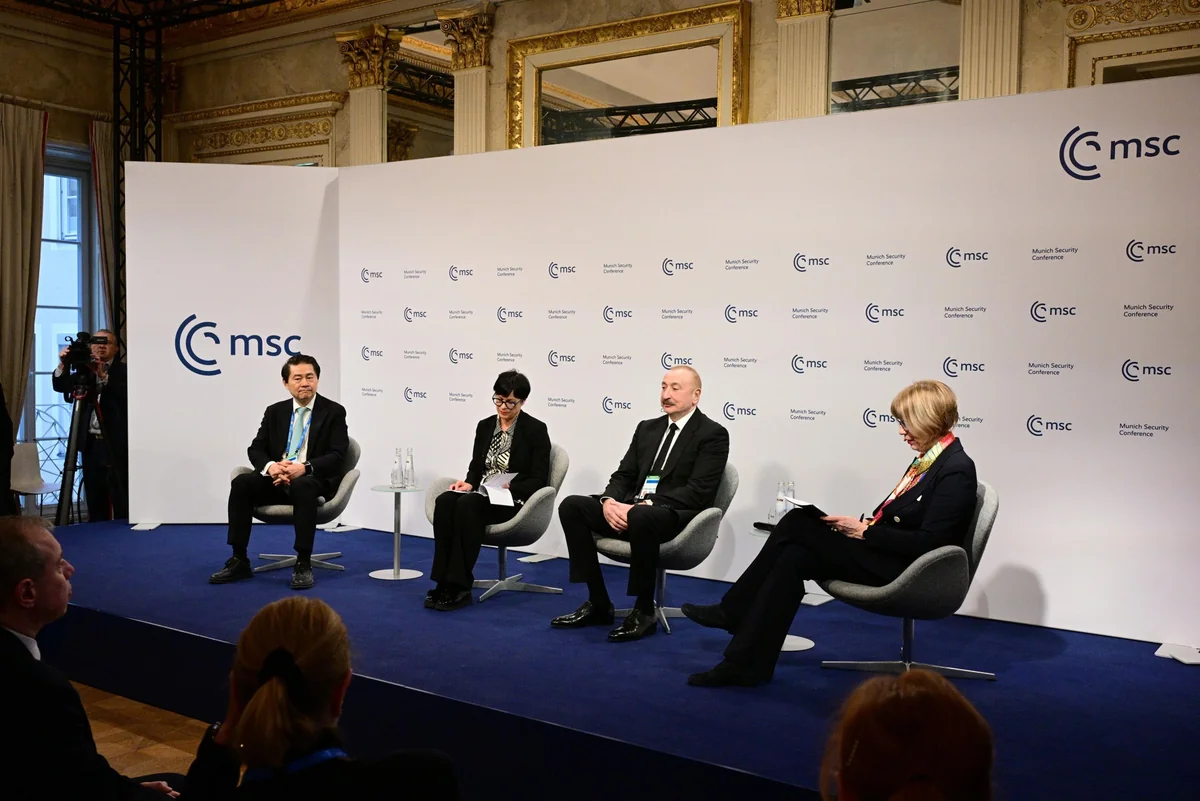
A panel discussion titled "Open Corridor Policy? Deepening Trans-Caspian Cooperation" was held as part of the Munich Security Conference on February 14.
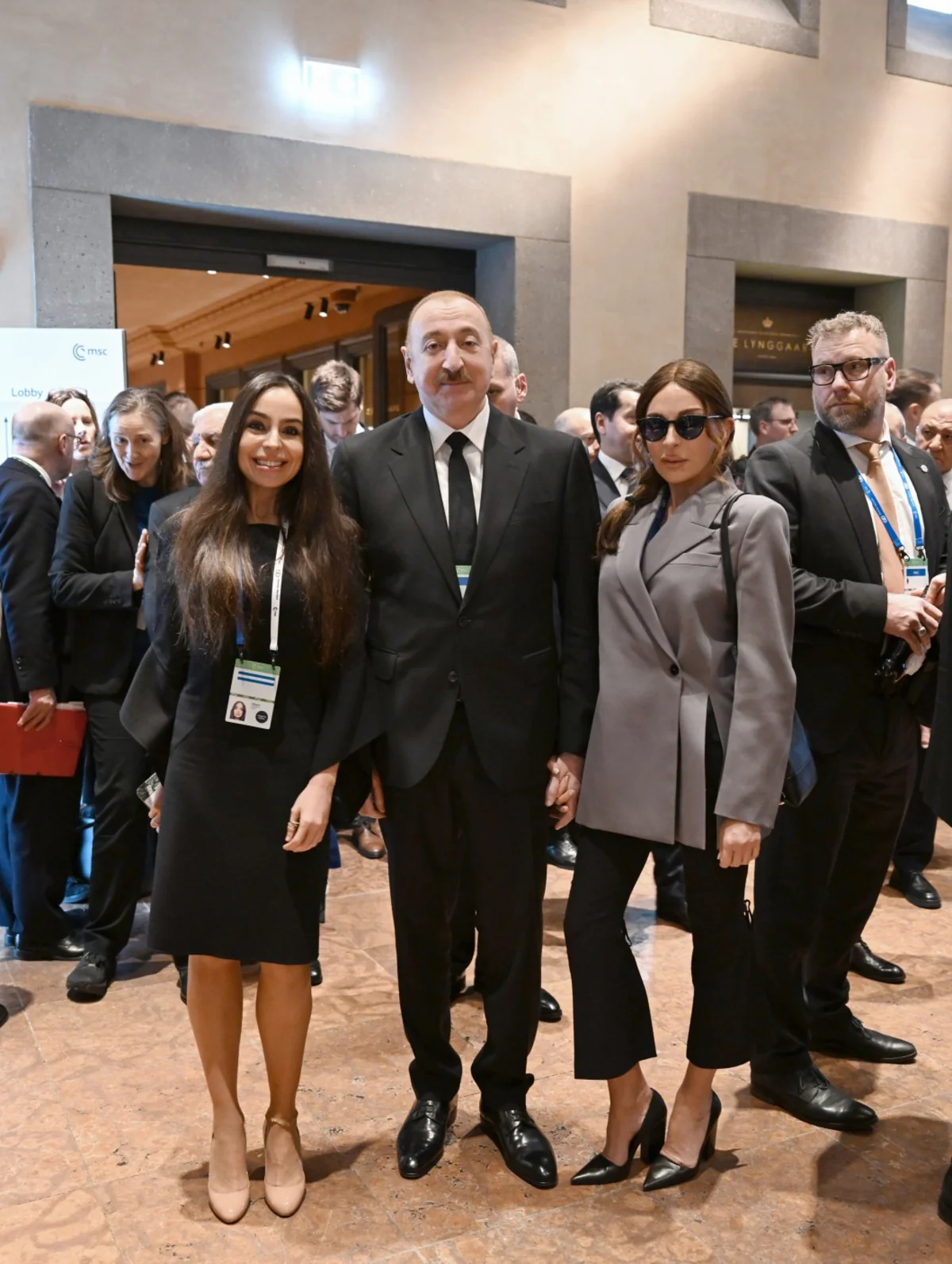
President of the Republic of Azerbaijan Ilham Aliyev, First Lady Mehriban Aliyeva, and Leyla Aliyeva participated in the discussion.
Moderator Helga Maria Schmid: I had the honor of being with you on the panel three years ago, then as Secretary General of the OSCE, promoting connectivity through the digitalization of trade routes. Your country has invested heavily in the Middle Corridor. So let me ask you: what the opportunities are for future Europe-Asia trade, also in terms of resilience and diversification, maybe also compared to alternative routes such as the Northern route via Russia?
President Ilham Aliyev: Thank you very much. Since we were last at the panel, many things have changed in our region, including corridors and connectivity. During this period of time, Azerbaijan largely invested in physical infrastructure, including seaports, railroads, highways, and air cargo transportation. Definitely, to become a regional transportation hub, you have to have good relations with your neighbors, and this is the case with Azerbaijan, whether it's to the West or to the East.
Azerbaijan's geographical position, being situated between Europe and Asia, is an advantage, but without physical infrastructure, it doesn't mean a lot. So last year, we had a record number of TU going through Azerbaijan, more than 100,000, and in a couple of years, it will go up to 200,000 and even 300,000. The target is 500,000 TU. For that purpose, we have already started the expansion of our trade sea port, and investments are already there.
Regional connectivity projects include not only railroads but also fiber optic. We are now working closely with our Central Asian partners on building the fiber optic cable under the Caspian Sea, which should be ready this year, and also thinking about new opportunities after peace with Armenia has been achieved. The corridor which goes through Azerbaijan to Armenia and further to European destinations has also great potential with respect to the volume of cargoes. Azerbaijan is now investing in railroad construction on its territory. The total length of the railroad to be constructed and renovated is 600 kilometers on Azerbaijani territory in both parts of Azerbaijan, in the mainland and the Nakhchivan exclave. The length in Armenia is slightly more than 40. So as soon as it is done, we will have two extensions of the Middle Corridor going through Azerbaijan, and this will be to the benefit of the West, the East, and, of course, the countries which are situated in the South Caucasus.
x x x
European Commissioner for Enlargement Marta Kos, highlighting that cooperation has been established in creating a global route involving Armenia and Azerbaijan, stated: "The peace process between Armenia and Azerbaijan is opening new doors, and what initially seemed unbelievable in terms of implementation now inspires confidence in us. We express our gratitude to President Aliyev for always providing his support to the European Union"s plans in this regard as well."
Marta Kos added, "Regarding the route from China to Europe, we would like to see it further diversified. Private companies seek choices that allow them to deliver more cargo in shorter periods. Ultimately, by 2030, we could see a threefold increase in transit volumes via the Trans-Caspian route. This represents the transport of massive cargo volumes, which is highly attractive for businesses."
"China"s relations with Azerbaijan, with Central Asia, and with other countries in that region have always been important," stated Wang Huiyao, founder and president of the Center for China and Globalization and former state councilor of the People"s Republic of China.
Discussing the "Belt and Road" Initiative, he noted: "This strategy is aimed at simplifying transportation carried out along that route. Of course, China wants to contribute to the expansion of new corridors and to the emergence of new projects."
Wang Huiyao noted that the "Belt and Road" initiative actually also encompasses countries in the Trans-Caspian region. "The Trans-Caspian route is also important," he added.
Wang Huiyao continued: "As you know, China is taking very good steps to reduce obstacles and make connectivity possible. Therefore, all these good achievements are beneficial. Azerbaijan is a friendly country. I have participated in the Baku forums many times and, of course, we have always admired Azerbaijan"s ‘soft power"."
Moderator: Last August, you signed a Joint Declaration with the Prime Minister of Armenia and the U.S. President. The Trump Route for International Peace and Prosperity, as it is called, TRIPP, was introduced. So I wanted to ask you how this fits into the broader Trans-Caspian cooperation scheme. And I cannot resist asking you, at this stage of the peace process with Armenia, what role connectivity plays as a confidence-building measure. Or more bluntly, are you going to sign a peace agreement this year?
President Ilham Aliyev: I hope we will sign a peace agreement this year. I have already spoken about that on numerous occasions, saying that the very fact that the peace agreement was initialed in the White House, in the presence of the President of the United States, plus the Joint Declaration, which was signed by the Prime Minister of Armenia and myself and also signed by President Trump as a witness, is enough to say that peace has already been achieved. From August up to now, we not only enjoy an absolutely new situation on our border, but there has been no shooting, no victims, no wounded, no problems. We have also started physical cooperation with Armenia. We lifted all the restrictions on the transportation of cargo through Azerbaijan. And we are grateful to our Georgian friends that they provide very important transit after the goods reach Azerbaijan and then go to Armenia through Georgia. We also started the supply of oil products to Armenia, which is a critical product for them, and thus actually started mutual trade.
So, from the point of view of a formal peace deal to be signed, everything depends on when Armenia's Constitution is amended in order to deduct the territorial claim against Azerbaijan, which has existed there for three decades. The next day, after it is done, the peace agreement will formally be signed. But in the meantime, the Trump Route for International Peace and Prosperity will also play an instrumental role in creating new connectivity links. As I already said, the transportation route from China, Central Asia, Trans-Caspian, Azerbaijan, Armenia, Azerbaijan"s exclave Nakhchivan, Türkiye, and further down to Europe will create an absolutely new situation. It will be beneficial to all the countries. All the countries on the route will be more politically and economically integrated, and this will be another contribution to long-lasting and eternal peace between Azerbaijan and Armenia. Because peace can be achieved when you really have a peaceful process. Signing the document is important. It is a foundation. But no less important is what you do after.
The time from the last bloody clash between Azerbaijan and Armenia to the Washington Summit was less than two years. I think this is a record number in all conflicts, especially conflicts which lasted for three decades. So both sides demonstrated strong political will to put an end to this confrontation and to open the chapter of peace. And we have lived in peace for only six months, and believe me, it is a very special feeling. It is a very good feeling, which is shared by the entire population of Azerbaijan, and I am sure of Armenia. Connectivity projects and corridors will unite us even more, make us interdependent, and create an absolutely new situation in the South Caucasus, where Azerbaijan, Georgia, and Armenia will at last start interaction on trilateral grounds.
x x x
Responding to a follow-up question, European Commissioner for Enlargement Marta Kos stated: "We have drafted concrete projects on the agenda for Azerbaijan, Armenia, and Türkiye. You mentioned the TRIPP project, which we also consider a priority. Although it covers only 42 kilometers, we intend to implement not only TRIPP but also complementary projects. Without those, its full impact would not be realized. For instance, securing a new rail outlet through Nakhchivan is a matter of great interest to all relevant institutions. I believe the private sector will also be able to put forward proposals based on these foundations."
"As you know, the decision-making process within the European Union is not always easy. However, in this current period, the implementation of the TRIPP project toward Nakhchivan will fundamentally change the landscape, subsequently providing a direct outlet to Türkiye," she emphasized.
Responding to the moderator"s question regarding whether the Middle Corridor could surpass the Northern Route in terms of cargo volume within 15 years, Wang Huiyao stated: "It seems to me that all parties will benefit in terms of prosperity. The countries in Central Asia are also developing very rapidly. China, as their neighbor, is also increasing its GDP. Trade can grow even further. I think that new corridors will give impetus to additional activities. Therefore, I believe this is valuable, efficient, and perhaps a next middle corridor project will emerge. I am quite optimistic. Trade, economic ties, and tourism – all these areas will be considered very necessary. In fact, we can develop tourism through new routes. For example, when you travel to China, you can use different routes. This could include railway connections. I think this will create more opportunities for us, and as Mr. President said, we need stability and sustainable peace. In such a case, more economic contacts will be established. Any of these or other routes will be beneficial. The most important thing is to gain experience from an economic perspective."
x x x
Afterward, the panel participants answered questions.
Question: Thank you for this insightful conversation. I am a Member of Parliament from Türkiye, and I'm also a Munich Young Leader. My question is that the future of this Middle Corridor relies greatly on U.S. interest, and what we know from the last year that we have gone through is that U.S. interest shifts drastically under this administration. So first, what do you think will happen if U.S. interest in this corridor changes? Second, how do you think the U.S. response to Iran will impact the future of this corridor? Thank you.
President Ilham Aliyev: I think the very fact that TRIPP bears the name of President Trump means that this corridor will be important for this administration and maybe beyond the term of this administration. Otherwise, the President would not have given his name. Giving the name means that it will be done, and after the name was approved, we are absolutely confident that the United States will be part of that.
According to the information we have now, the United States and Armenia are discussing the parameters of the functioning of the company which will be entitled to physical construction and investments. It is already in open sources. We know that 76% of the company will belong to the United States, 24% to Armenia, for the first 49 years, and then there will be another 49 years; in other words, this format will be functional for one century.
Second, as you correctly mentioned, there have been different approaches from the American administration to connectivity projects in our region, and only when President Trump came to power did we start to see a big interest. In other words, all that has been done by the countries of the region - Azerbaijan, Georgia - and by our neighbors across the Caspian in Central Asia was done without any practical American involvement. So we did it together with Türkiye, ourselves. We can name the oil pipeline through Azerbaijan, Georgia, Türkiye, the gas pipeline which stretches down to Europe, and the Baku-Tbilisi-Kars railroad; all were done without any practical American involvement. So we did it ourselves. Today, when we have such a big asset as President Trump's administration concentrated on that, of course, the potential for implementation of these large-scale projects is much larger in scale.
One thing I also want to underline: we talked about the countries of the region, and we should not forget our neighbors across the Caspian in Central Asia. Because without them, it will not be possible to ship any cargo from China to Europe. So it's China, Central Asia, the Caspian, Azerbaijan, Georgia, Armenia, Türkiye, Europe - this is the geography, and Azerbaijan now already is very active in interaction with Central Asian countries. Last November, Azerbaijan was officially incorporated into C5; the Central Asian Five became C6. This is an unprecedented development because we are a country of the South Caucasus, but we are members of the Central Asian Consultative Council.
A lot we do on connectivity, and a lot is being done between Central Asian countries and China on connectivity. Along with the existing roads, which Madame Helga underlined, there is also the road which is being built and financed by China - another road to the Caspian - apart from the existing one from China to Kazakhstan to the Caspian. China is now financing China–Kyrgyzstan–Uzbekistan–Turkmenistan–Caspian. And again, it comes to the Caspian. That means it will come to Azerbaijan and further down through the South Caucasus to Europe. So there is a lot of geopolitics, a lot of international relations, a lot of diplomacy, and Azerbaijan is a country which managed to initiate and lead these transnational projects, like the oil pipeline from Baku to the Mediterranean, the gas pipeline from Baku to Italy, going along the route of many countries, with all of them having good relations. So it will be another very strong political guarantee for cooperation across the very large geography of Eurasia.
x x x
Marta Kos noted that attracting companies, the active role of political participants, building trust among partners, opening new routes in the direction of Iran, and Türkiye's preparations for railway projects all serve to expand opportunities overall. She added: "Centuries pass, yet we must think about these changes right now. Perhaps in the past, this seemed incredible to us, but paths are opening for the future, and regional leaders understand how we can benefit from this-how Europe can benefit-and, of course, this is also beneficial for Azerbaijan. This is how it should be. This is good for Europe because it provides better access to China. This access will be ensured through Central Asia. Resolving all these conflicts and geopolitical challenges is not an easy matter."
Wang Huiyao stated: "Regarding the route mentioned by Mr. President, I believe that China is currently providing assistance to Central Asian countries, and plans are being made to gain access to Türkiye through the Caucasus. Here, it is not just that specific route, but also cooperation in the energy sector that is envisaged. Naturally, as a result, production can develop further, and investments can be attracted. In short, this is a good example. We believe that a sustainable infrastructure for this already exists."
Question: Thank you very much. My name is Stepan Safaryan. I'm a member of the Young Leader group coming from Armenia. Mr. President, just before asking my question, just one observation: the provision of Armenia's Independence Declaration you were speaking about and expressing some concerns about is not effective. And your administration - not only your administration, but also other governments - are quite well acquainted with the Constitutional Court's decision on that matter, and the Constitutional amendments right now in Armenia have nothing in common with those claims and fears. But let me remind you of another very prominent initiative, which was signed not only last August 8 in Washington, but also before that, during the administration of Biden. It's about the Crossroads of Peace initiative, and the Commissioner is quite right. TRIPP is about 42 kilometers. But this initiative, the Crossroads of Peace initiative, is quite an interesting initiative in terms that it calibrates all the connectivity initiatives - be it the Silk Road, be it the Belt and Road, be it the Trans-Caspian Corridor or the Gulf-Black Sea Corridor. So it is very inclusive. It includes Georgia and other countries in the region. So what is your attitude toward this very important detail? What does it bring to this dynamic, especially when it is stipulated that it is supported by both administrations in Washington for a long-term period, not only for, let's say, a four-year term, but 400 years - or even more? Thank you.
President Ilham Aliyev: With respect to the legal issue of the Armenian Constitution, I didn't want to go into many details, but your comment just forced me to say that the declaration of independence of Armenia, which contains the direct territorial claim to Azerbaijan, is part of your Constitution, and the Constitution - yes, it is. It is in the preamble. Let's have a check now on Wikipedia, probably before we finish. So no decision of the Constitutional Court is higher than the Constitution. I'm not a lawyer, but even I know that. Therefore, the deduction of the declaration of independence from the Constitution of Armenia is the only remaining prerequisite for signing a peace agreement. And I think there is much understanding between the Armenian and Azerbaijani leadership about what should be done and in what consequence. With respect to the so-called Crossroads of Peace, you know, when President Trump came back, he launched TRIPP. So when President Biden comes back, he will relaunch your Crossroads of Peace.
x x x
In response to a question from the representative of Mongolia regarding which real steps should be taken to simplify customs procedures on routes passing through the borders of 14-16 countries, to increase the efficiency of transit, and the active role that the World Bank and the European Bank for Reconstruction and Development could play in this process, Marta Kos stated: "I believe that all ministers should take steps in this direction, governments should work, and all countries-including the 27 countries of the European Union, Azerbaijan, Armenia, Türkiye, and the Central Asian states-should consider what we need to do to remove those barriers. How should we work so that these efforts are carried out mutually at the international level? Therefore, if such a platform exists, we will be able to create mutual interaction not only between government officials but also between business structures and institutions. If we succeed in this, things will proceed much more easily, and thus we will be able to remove those barriers quite comfortably."
Question: Russian attacks hit not only the energy infrastructure of Ukraine, but also energy facilities owned by Azerbaijani companies in Ukraine. So my question is, did you personally address this to Putin, and how do we see these attacks? Is that a signal to Baku, or what is happening in your relationship with Russia?
President Ilham Aliyev: Definitely, this issue was raised many times during numerous contacts between our officials at the level of foreign ministries and at the level of presidential administrations. There have been not only attacks on Azerbaijan's energy infrastructure in Ukraine, but also three attacks on Azerbaijan's Embassy in Ukraine.
After the first attack, we could imagine that it was accidental, and we gave our Russian colleagues all the coordinates of Azerbaijan's diplomatic representations, including the consular department, our cultural centers, and the embassy. Despite all that, there have been two more attacks. So that was a deliberate attack on Azerbaijan's diplomatic representation. We issued special statements, and the ambassador was invited and a diplomatic note was submitted. We act only in a diplomatic way. We cannot do anything else. But of course, it's something which is considered to be unfriendly to Azerbaijan. And I understand your question and just want to inform you that all the necessary diplomatic steps have been taken by the Azerbaijani government.
x x x
Moderator: With this, we have come to the end. I believe we had a very interesting panel session, with many interesting and strong messages delivered. Now, I would kindly ask the entire audience to once again applaud our participants.
A panel discussion titled "Open Corridor Policy? Deepening Trans-Caspian Cooperation" was held as part of the Munich Security Conference on February 14.
President of the Republic of Azerbaijan Ilham Aliyev, First Lady Mehriban Aliyeva, and Leyla Aliyeva participated in the discussion.
As part of the Munich Security Conference, a panel discussion titled "Open Corridor Policy? Deepening Trans-Caspian Cooperation" has commenced, Report informs.
President of the Republic of Azerbaijan Ilham Aliyev, First Lady Mehriban Aliyeva, and Leyla Aliyeva are participating in the discussion.