
 Baku 24° C
IATA: SAF transition progressing much slower than expected
- 07 June, 2026
- 10:42
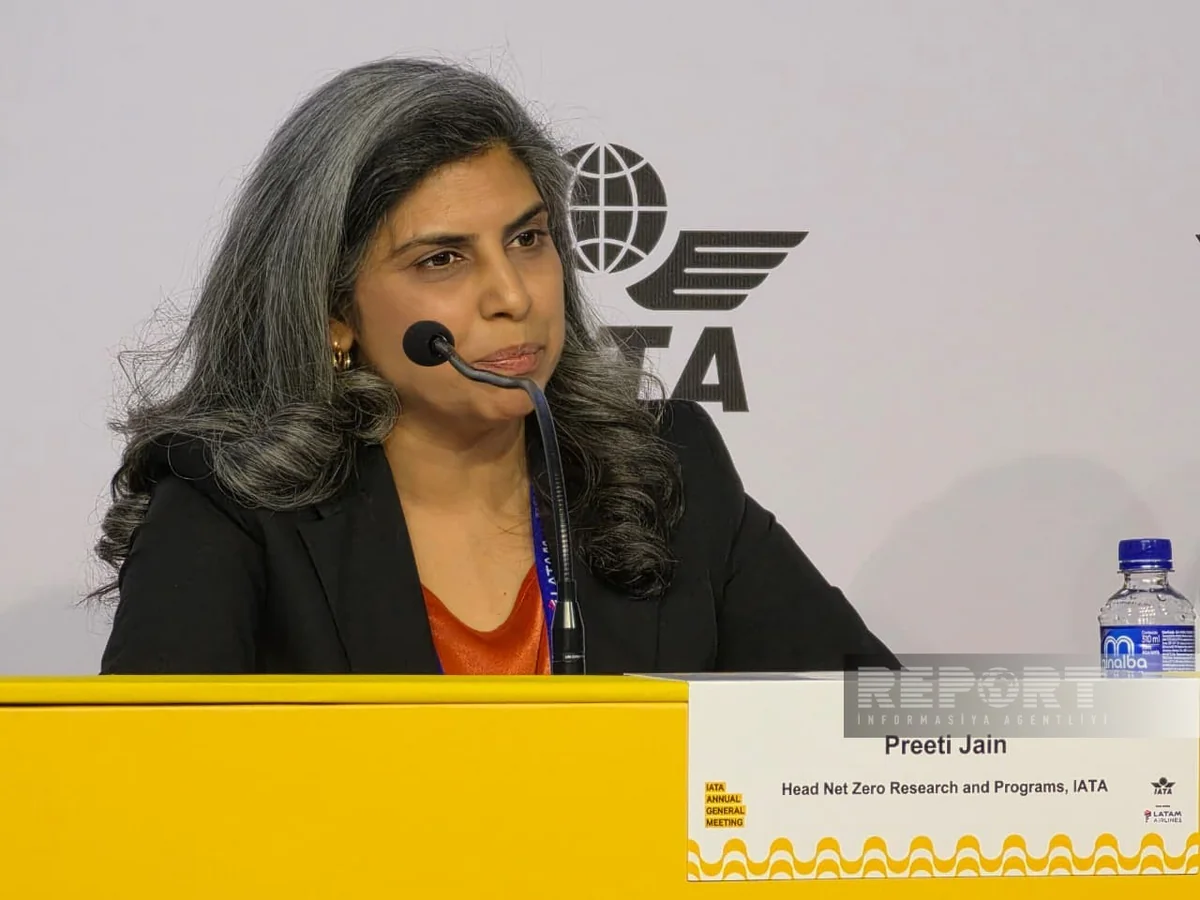
The global aviation industry's transition to sustainable aviation fuel (SAF) is progressing much more slowly than expected, and many projects announced to increase production capacity by 2030 may not materialize without changes in government policy.
Report"s correspondent dispatched to Rio de Janeiro informs that Preeti Jain, Head of Net Zero Research and Programs at the International Air Transport Association (IATA), said this at a press conference held as part of IATA"s 82nd Annual General Meeting (AGM) and World Air Transport Summit (WATS).
According to her, IATA has kept its forecast for global SAF production in 2026 at 2.4 million tons, which accounts for less than 1% of the aviation industry's total fuel demand.
"The reason lies in the existing regulatory framework. Today, in many countries, policies are structured in such a way that it is more profitable for producers to manufacture renewable diesel rather than SAF. That is why SAF production volumes at these facilities remain significantly low," Jain said.
She noted that IATA is monitoring the development of more than 370 SAF production projects worldwide.
"We are seeing a significant increase in announced capacity. However, I deliberately refer to 'announced' projects because many of them are unlikely to reach a final investment decision or the next stage of development by 2030," the IATA representative emphasized.
According to her, the Americas will be the leading region in terms of potential SAF supply by the end of the decade. In terms of production capacity, it will be followed by Europe, North Asia and the Asia-Pacific region.
Author