Baku 15° C
Dublin EPC Summit highlights Azerbaijan's growing role in European agenda
- 13 November, 2026
- 19:11
Stay up to date with the top news!
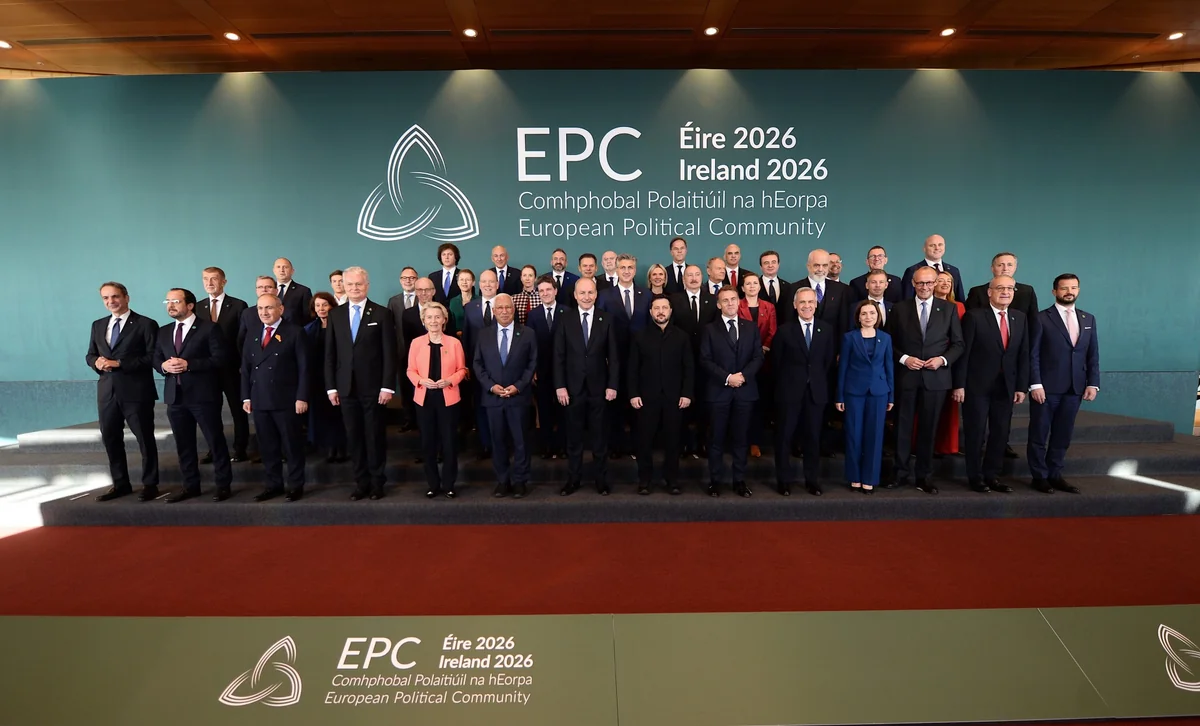
The ninth summit of the European Political Community (EPC), held in Dublin on November 12, provided Azerbaijan with an opportunity not only to present its positions on key European and regional issues but also to advance bilateral cooperation with a number of European countries. The signing of a declaration on strategic partnership with the United Kingdom, discussions on energy security, transport connectivity and prospects for peace in the South Caucasus demonstrated that Baku's importance to Europe extends beyond its role as an energy supplier.
The EPC format itself reflects a broader understanding of European security and cooperation. Established in 2022 at the initiative of French President Emmanuel Macron, the community brings together EU member states and countries outside the bloc, providing a platform for discussions on common challenges.
Addressing the summit, Irish Prime Minister Micheál Martin stressed that the EPC's strength lies precisely in extending dialogue beyond the European Union to other countries across the European continent and beyond. Citing Azerbaijan as an example, he pointed to significant developments associated with its participation in the community, including in the area of supplies. Martin also recalled that Azerbaijani-Armenian relations had been discussed at the EPC's very first meetings.
Swiss President Guy Parmelin expressed a similar view, emphasizing that not only the European Union but the entire European continent has an interest in the effective functioning of the wider European space. In this context, the South Caucasus is important not only as a region directly concerned with stability but also as an area whose development affects broader European interests.
Azerbaijan's energy role
Energy security was one of the central topics of the Dublin summit. Speaking at a roundtable titled "Building a Competitive Europe – Innovation, Connectivity and Affordable Energy", President Ilham Aliyev recalled the 2022 Memorandum of Understanding on a Strategic Partnership in the Field of Energy between Azerbaijan and the European Union.
He said that since then, Azerbaijani gas supplies to the EU had increased from 8 billion to 13 billion cubic metres. The Azerbaijani leader also noted that the pipeline network connecting Baku to Italy through seven countries supplies 10 EU member states and is currently operating at full capacity. This, he said, makes expanding infrastructure capacity essential for further increasing supplies.
Energy cooperation also featured prominently in the Azerbaijani president's bilateral meetings. During talks with Greek Prime Minister Kyriakos Mitsotakis, the parties discussed Azerbaijan's role in ensuring Europe's and Greece's energy security, the importance of the Trans Adriatic Pipeline (TAP) and opportunities to increase Azerbaijani gas exports. They also addressed the need to review the EU's financial and procedural mechanisms.
In his meeting with Czech Prime Minister Andrej Babiš, the Azerbaijani leader discussed energy cooperation, including oil supplies from Azerbaijan, which was described at the meeting as the Czech Republic's largest oil supplier. Talks with Romanian President Nicușor Dan focused on prospects for energy cooperation and the development of links between the Caspian and Black seas.
The meeting with Moldovan President Maia Sandu was also significant. She expressed interest in further developing energy cooperation with Azerbaijan and thanked Baku for supporting her country's energy security. This demonstrates that cooperation with Azerbaijan in the energy sector is sought not only by Europe's largest markets but also by other countries across the continent.
During a meeting with European Council President António Costa, the parties discussed long-term energy contracts and financial mechanisms needed to sustain cooperation in gas supplies. They also addressed renewable energy development and prospects for exporting green energy to the European market under agreements involving Azerbaijan, Georgia, Türkiye and Bulgaria.
Connectivity and peace in the South Caucasus
Transport connectivity was another important area of discussion. Talks with Costa covered the significance of the Middle Corridor and the European Union's assessment of the railway project in Nakhchivan, which, according to the statement issued after the meeting, is expected to be completed in the near future.
Regional connectivity featured prominently in Ilham Aliyev's meeting with Armenian Prime Minister Nikol Pashinyan. The leaders discussed practical steps to advance the peace agenda following the August 8, 2025, Washington summit. Topics included transport and transit, trade, economic relations, border delimitation and confidence-building measures.
The prospects for implementing the TRIPP project were also discussed, including the planning and design of railway and road sections. The parties welcomed the transit of goods to Armenia through Azerbaijani territory: 105,000 tonnes of cargo had been transported via this route since November 2025. They also discussed opportunities to expand trade, future electricity grid interconnections and cooperation on transboundary water resources.
These issues demonstrate that the peace process in the South Caucasus is gradually acquiring a practical economic and infrastructure dimension. For Azerbaijan, this is important not only in terms of bilateral relations with Armenia but also in the broader context of developing transport and energy links between Europe and Asia.
New areas of partnership
One of the key outcomes of Azerbaijan's participation in the summit was the signing by Ilham Aliyev and UK Prime Minister Andy Burnham of a Joint Declaration on Strategic Partnership between the two countries. The document covers cooperation in defence and security, trade, investment, transport infrastructure, renewable energy, education and innovation.
The development of the Middle Corridor and investment cooperation feature prominently in the declaration. The parties also reaffirmed their support for Azerbaijan's and Armenia's efforts to achieve lasting peace. The declaration is a bilateral document and represents a separate outcome of talks between Baku and London on the sidelines of the summit.
The Dublin meeting with Ukrainian President Volodymyr Zelenskyy highlighted another area of cooperation. Zelenskyy thanked Azerbaijan for its humanitarian assistance, particularly supplies of electrical equipment. He also expressed interest in the reconstruction and construction projects being carried out by Azerbaijan in Garabagh and Eastern Zangazur, noting that this experience could be valuable for Ukraine.
Overall, Azerbaijan's participation in the ninth EPC summit produced several complementary outcomes. On the one hand, Baku reaffirmed its role in ensuring Europe's energy security and developing transport connectivity. On the other hand, it demonstrated its readiness to contribute to a practical agenda of peace and cooperation in the South Caucasus while sharing its own reconstruction experience.
For Azerbaijan, the summit was also a successful platform for bilateral diplomacy. Alongside the signing of the strategic declaration with the United Kingdom, meetings were held with the leaders of European countries and institutions, as well as Armenia, Ukraine and Moldova. This is particularly significant ahead of Azerbaijan's hosting of the European Political Community summit in 2028.
Author