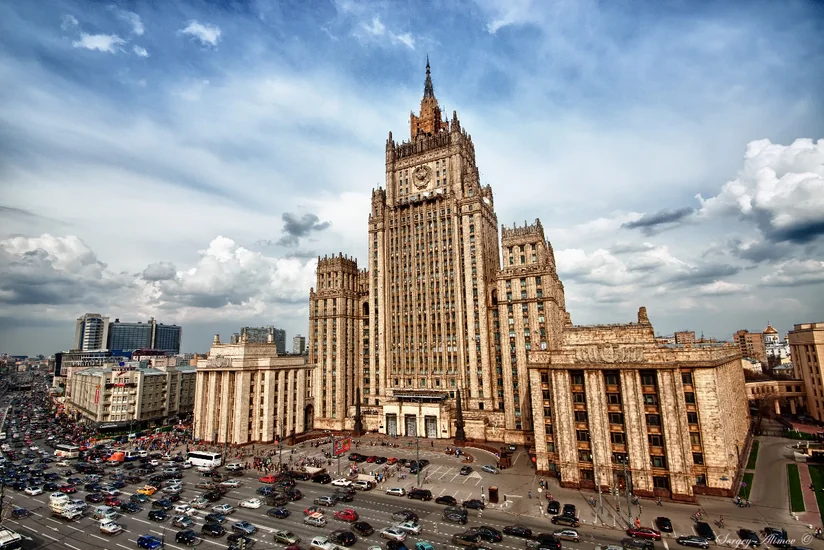
Russia (officially the Russian Federation, rus. Россия, Rossiya) is the largest country in the world by total area, spanning over 17.1 million square kilometers across two continents, covering eastern Europe and the entirety of northern Asia. Bounded by fourteen land borders with European and Asian nations and vast coastlines along the Arctic and Pacific oceans, as well as the Baltic, Black, and Caspian seas, Russia is a federal semi-presidential republic with its capital and largest city in Moscow. As a nuclear-armed superpower and a permanent member of the United Nations Security Council, Russia plays a defining role in global geopolitics, energy markets, and international affairs.
Vast Expanse: Encompassing eleven time zones, Russia features an immense variety of landscapes, ranging from tundra and the vast Siberian taiga forests to immense steppe plains, mountain ranges like the Urals and the Caucasus, and the fertile river basins of the Volga and Don.
Natural Resources: The country possesses the world's largest reserves of natural gas, vast oil deposits, extensive coal fields, and immense reserves of fresh water (including Lake Baikal) and precious minerals.
Early Roots and Tsardom: The origins of Russian statehood trace back to Kievan Rus' and subsequent principalities like Vladimir-Suzdal and the Grand Duchy of Moscow, which unified the lands into the Tsardom of Russia under Ivan the Terrible.
Russian Empire: Following reforms by Peter the Great, the Russian Empire emerged as a major European power, expanding across Siberia and Central Asia until the collapse of the monarchy in 1917.
Soviet Era: The Russian Soviet Federative Socialist Republic became the core and largest constituent republic of the Soviet Union (USSR), a global superpower that played a decisive role in defeating Nazi Germany in World War II and pioneering space exploration.
Russian Federation: Following the dissolution of the USSR in December 1991, the modern Russian Federation was established as an independent sovereign state.
Energy Superpower: The Russian economy is heavily driven by the extraction and export of oil, natural gas, and refined petroleum products, anchoring energy security across Eurasia.
Industrial and Agricultural Sectors: Beyond energy, Russia maintains a heavy industrial base encompassing aerospace engineering, nuclear power technology, defense manufacturing, metallurgy, and substantial agricultural production as a leading global exporter of wheat and grains.
Global Literary and Musical Legacy: Russia has contributed timeless masterpieces to world culture through legendary writers such as Leo Tolstoy, Fyodor Dostoevsky, and Anton Chekhov, and classical composers like Pyotr Tchaikovsky, Sergei Rachmaninoff, and Igor Stravinsky.
Scientific Achievements: The nation boasts a rich history of scientific and technological innovation, highlighted by pioneering milestones in space exploration, mathematics, theoretical physics, and engineering.

 Baku 22° C