Baku 21° C
The Times of Central Asia: US strengthening cooperation with Azerbaijan and Central Asian countries
- 15 July, 2026
- 11:15
Stay up to date with the top news!
The visit of Senator Steve Daines, a member of the US Senate Committee on Foreign Relations and Chairman of the Subcommittee on Europe and Regional Security Cooperation, to Azerbaijan, Kazakhstan, and Turkmenistan strengthened Washington's emerging strategy of building ties with the South Caucasus and Central Asia, reads an article published on The Times of Central Asia, Report informs.
The publication notes that in Baku, Azerbaijani President Ilham Aliyev and Senator Daines discussed Azerbaijan's geopolitical role, regional peace, and the importance of the Trump Route Project (TRIPP) for transportation connectivity.
Separate meetings with Foreign Minister Jeyhun Bayramov and Economy Minister Mikayil Jabbarov expanded the agenda to include economic cooperation. In addition, during his talks in Baku, the senator discussed the Middle Corridor, energy, transportation, digital development, and the extraction and processing of critical minerals.
"The US–Azerbaijan Strategic Partnership Charter, signed in February, places the Middle Corridor alongside energy, trade, transit, digital connectivity, and critical-mineral movement. It identifies Azerbaijan as an energy, transport, trade, and logistics hub for the Caspian region," reads the article.
The author emphasizes that the United States and Azerbaijan held their first economic dialogue in June, during which they discussed a wide range of issues.
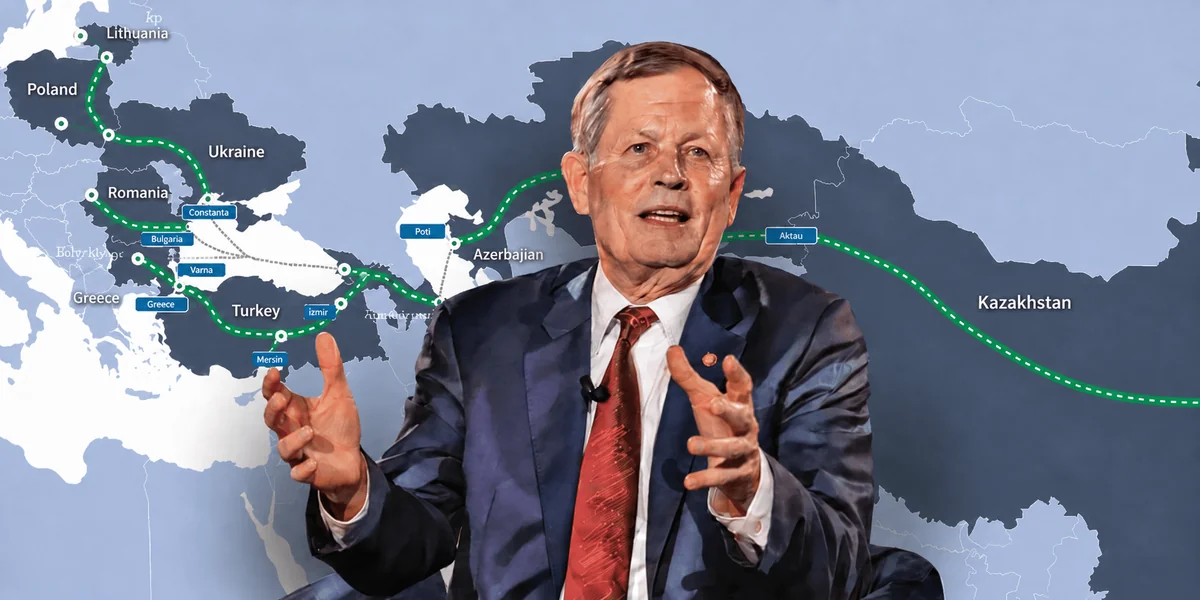
"Azerbaijan's role also rests on physical infrastructure already in use. The established Middle Corridor crosses Kazakhstan and the Caspian before passing through Azerbaijan and Georgia, then onward toward Türkiye or Europe via the Black Sea. At Alat, 70 kilometers south of Baku, the port handled 7.6 million tons of cargo in 2024. Its annual capacity is 15 million tons and 100,000 TEU; the planned second phase would raise those figures to 25 million tons and 500,000 TEU," reads the article. "Westward links already carry some oil from Kazakhstan and Turkmenistan, and the Trans-Adriatic Pipeline has transported gas to Europe since the end of 2020. TRIPP would add a route through southern Armenia toward Nakhchivan and the existing Azerbaijan-Georgia-Türkiye network. The immediate policy challenge is to expand operating routes and complete unfinished connections within a system already carrying traffic."
The publication notes the important role of all three countries: Kazakhstan provides freight volumes and mineral potential; Turkmenistan adds energy capacity; Azerbaijan is the western Caspian transport hub, possessing developed infrastructure for onward shipments and the most advanced institutional base.
"Daines's tour gave visible momentum to an emerging US strategy for connecting Central Asia and the South Caucasus, consistent with the Trump administration's emphasis on commercially grounded partnerships. Its institutional and financial architecture remains incomplete, but the direction is increasingly clear," the author wrote.
In his opinion, US relations with Azerbaijan, Kazakhstan and Turkmenistan are developing through bilateral agreements, dialogues, trade agreements and high-level visits.
"Regional stability acquires a commercial meaning here: infrastructure and investment require politically usable routes, predictable transit arrangements, and sustained cooperation across the Caspian Sea and the South Caucasus," the author added.
Author