Baku 19° C
Euronews publishes feature on outcomes of WUF13 in Baku
- 22 May, 2026
- 22:46
Stay up to date with the top news!
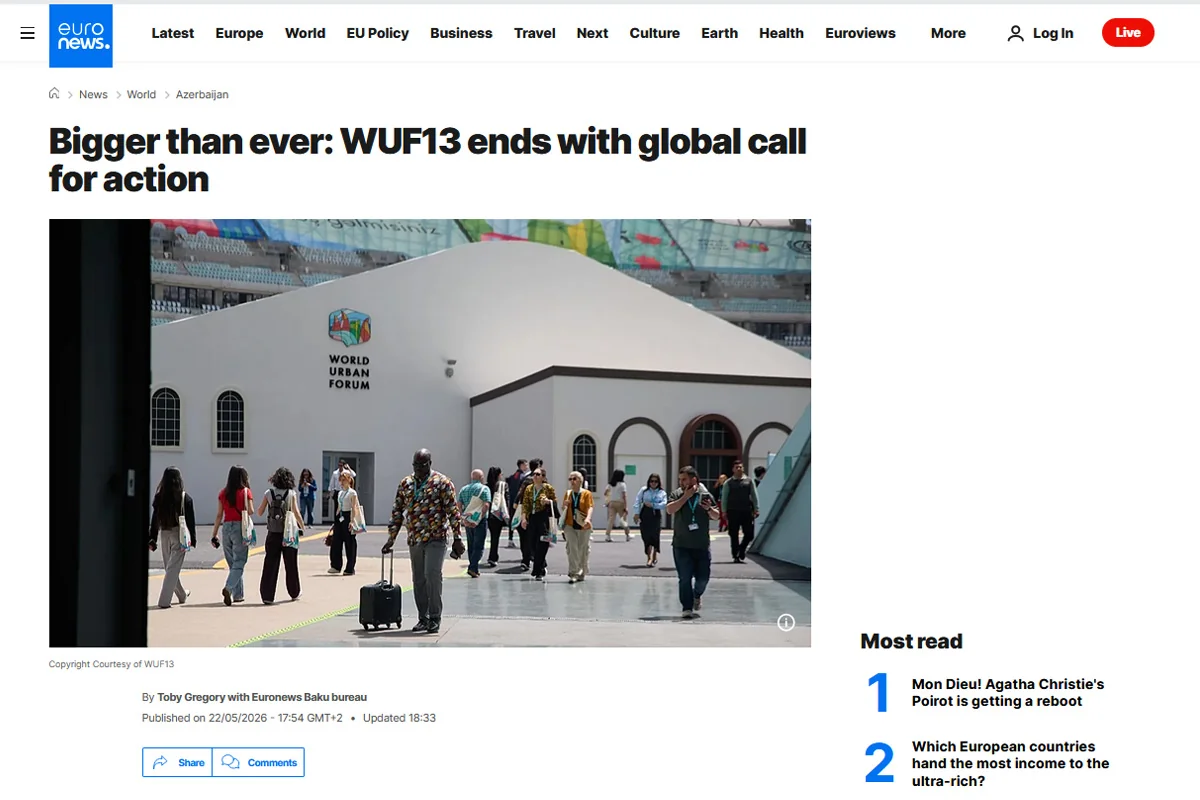
Euronews has published a feature dedicated to the outcomes of the World Urban Forum (WUF13) in Baku.
According to the article, cited by Report, the article states that discussions at the forum on the future of cities went beyond architecture, infrastructure, and urban landscapes, shifting toward the pressing global question of how cities can withstand conflict, climate change, rapid urbanization, and inequality without leaving local communities behind.
Housing has become a "systemic global challenge that shapes inequality, opportunity, resilience, and stability and peace in our cities and societies," Executive Director of UN-Habitat Anacláudia Rossbach said at the conclusion of the World Urban Forum (WUF13) in Baku on Friday.
According to her, housing affordability, displacement, and vulnerability to climate change are among the key drivers of this global challenge.
Affordability pressures, displacement and climate vulnerability are the main reasons for this major world issue, Rossbach explained.
Rossbach said the Forum's concluding statement, called the Baku Call to Action, emphasised the complexity of finding housing solutions that integrate land, finance, infrastructure and governance to achieve climate-resilient, inclusive cities through urban transformation.
The World Urban Forum in Baku gathered more than 57,000 participants from over 176 countries, with Rossbach hailing the participation by stating that "never before has a forum of this nature brought together such as vast and diverse global audience".
WUF13 National Coordinator Azerbaijan's Anar Guliyev said that "the theme of WUF13 placed housing at the centre of the global urban agenda and reaffirmed that access to adequate, affordable, safe and resilient housing remains one of the defining challenges of our time."
In an interview with Euronews at the WUF13, UN Deputy Secretary-General Amina Mohammed warned about the scale of this global challenge.
She warned against "just siloing the issue of housing, because this is not just about a house or a home, it's about community and it"s about a life of dignity."
She stressed that the housing issue cannot be viewed in isolation, as it concerns not only housing itself, but also the broader concepts of community and dignified living.
Mohammed noted that by 2050 more than 70% of the world's population will live in cities, and that the international community has an opportunity to lay the foundations for change by 2030.
According to her, solutions should focus on making cities more resilient and inclusive, which would accelerate development provided there is coordinated action.
She also warned of the possible emergence this year of a "super El Niño," which could bring extreme heat to many countries already facing climate pressures, as well as new floods for which the world remains unprepared.
Mohammed stated that the international community is reducing development investment, exacerbating humanitarian crises and making them more difficult to address.
She further noted that the global housing crisis is deepening social inequality, weakening the social contract, eroding trust in institutions, and diminishing quality of life.
She separately highlighted the challenges facing young people, who are increasingly unable to afford housing in cities amid rising prices and declining rental affordability.
According to her, this is contributing to growing anxiety and mental health issues among young people.
Mohammed also pointed to the mismatch between educational attainment and young people's ability to succeed in the labor market and afford housing.
In turn, Assistant to the President of Azerbaijan and Head of the Foreign Policy Affairs Department of the Presidential Administration Hikmat Hajiyev told Euronews that Azerbaijan's post-conflict reconstruction experience became one of the key themes of WUF13.
He emphasized that Azerbaijan is rebuilding nine cities and around 300 settlements and villages that were destroyed and mined as a result of the conflict.
According to him, the country is applying modern urban planning approaches to ensure the safe and dignified return of displaced persons.
Hajiyev also stated that the destruction of cities is increasingly being observed across various regions of the world, including Europe, the Middle East, and Africa.
He noted that Azerbaijan's experience could be valuable to the international community and that the country is ready to share it.
He also highlighted Azerbaijan's historical heritage in urban development, pointing to the country's ancient cities and their role in the regional history of trade and knowledge.
According to him, modern Baku demonstrates a combination of historical and contemporary architecture, reflecting the continuity of urban development.
As WUF13 concluded, Mexico was officially welcomed into the World Urban Forum family, with Azerbaijan and Mexico expected to work closely together in preparation for WUF14.

Author