Baku 19° C
TRIPP to boost South Caucasus economy - Azerbaijani deputy FM
- 24 September, 2026
- 11:23
Stay up to date with the top news!
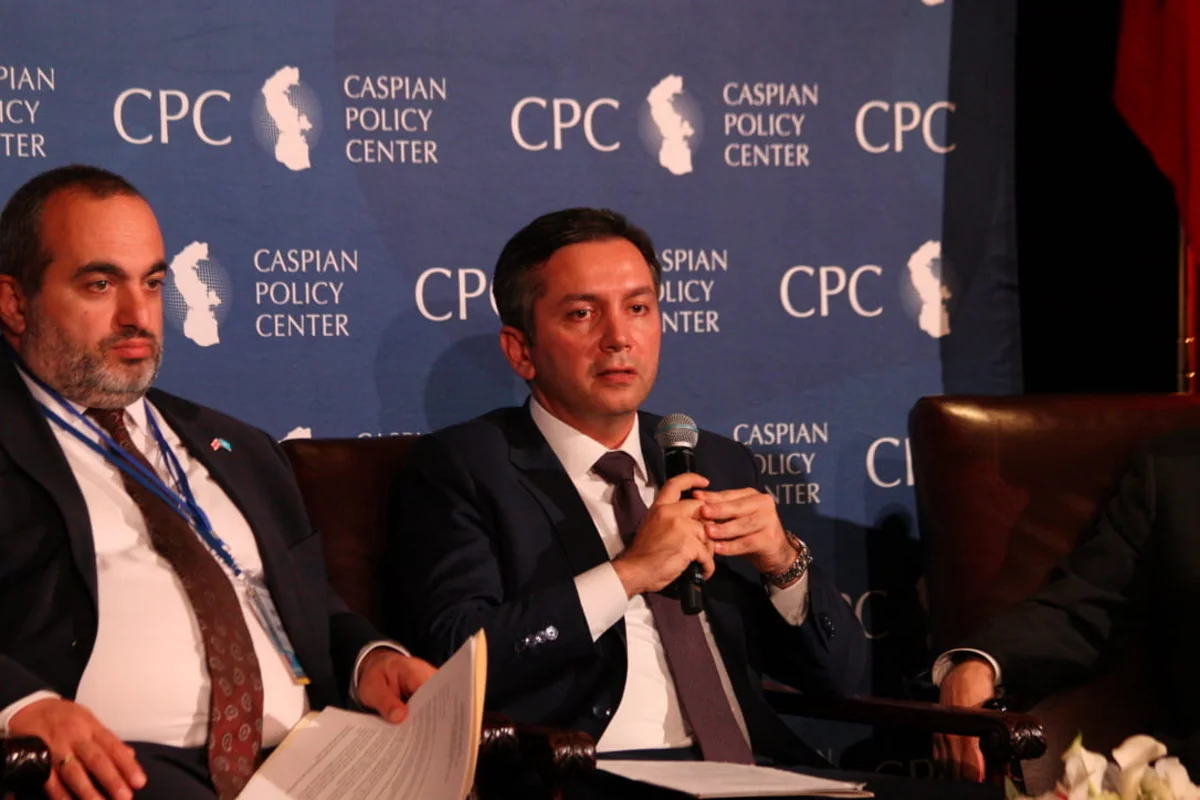
The Trump Route (TRIPP) is a significant project capable of simultaneously providing a new impetus to the economy of the South Caucasus and contributing to the consolidation of peace, Yalchin Rafiyev, Deputy Minister of Foreign Affairs of Azerbaijan, said at the seventh annual Caspian Business Forum organized by the Caspian Policy Center (CPC) in New York, Report informs.
"For Azerbaijan, efficient regional links mean shorter and predictable routes, more resilient supply chains, improved access to markets, and, of course, new opportunities for trade and investment," Rafiyev said.
Rafiyev pointed to Azerbaijan's investment in infrastructure, including the Port of Baku, the Alat Free Economic Zone, and the modernized Baku–Tbilisi–Kars railway, while stressing that physical infrastructure must be accompanied by more efficient border procedures and digitalized customs systems.
He also highlighted TRIPP's potential to reinforce both economic cooperation and regional peace. "TRIPP is an important project that will not only support the countries in the region economically and provide commercial value, but it will also be another example of an initiative that brings peace to the region, with shared interests for all the countries," Rafiyev said.
Efgan Nifti, Executive Director of the Caspian Policy Center, also addressed the forum. He noted the significant changes that have occurred in the Caspian region over the past year, as well as the growing role of the Middle Corridor (Trans-Caspian International Transport Route) as a trade and transport artery linking Asia and Europe. Nifti stressed that for the corridor to fully realize its potential, it must increasingly function as a single integrated system with harmonized border procedures, coordinated ports and railways, and digital documentation. The current task, he noted, is not simply to build more infrastructure, but to make the entire corridor faster, more reliable, and easier for businesses to utilize.
Peter Andreoli, US Deputy Assistant Secretary of State for European and Eurasian Affairs, described TRIPP as a new model of US engagement with regional countries regarding connectivity development. He stated that the route could become a vital link within the broader Middle Corridor, adding that the TRIPP initiative marks a shift in the approach of the US and its regional partners to developing regional connectivity.
Mark Cameron, US Deputy Assistant Secretary of State for South and Central Asian Affairs, underscored that Washington's interest in the region has reached an unprecedentedly high level. He welcomed the completion of the Trans-Caspian fiber-optic cable connecting Kazakhstan and Azerbaijan, highlighting the resulting opportunities for expanding digital connectivity and technology investments. Cameron also pointed to the broader development of bilateral commercial ties between the US and Central Asian nations.
Georgian Deputy Foreign Minister Lasha Darsalia characterized the Middle Corridor not merely as an alternative trade route, but as a crucial component of the Eurasian transport connectivity architecture. Erzhan Kazykhan, Special Representative of the President of Kazakhstan, emphasized the strategic importance that Kazakhstan attaches to the Middle Corridor and noted the additional opportunities TRIPP can create for connecting Central Asia with European markets.
Kyrgyz Minister of Economy and Commerce Bakyt Sydykov pointed out that transport accessibility is a vital issue for the landlocked countries of Central Asia. He stated that this accessibility directly impacts economic competitiveness, the cost of doing business, the ability to attract investments, and the access of Kyrgyz companies to global markets.
Congressman Abraham Hamadeh, who also spoke at the event, highlighted the economic opportunities that could emerge from establishing a lasting peace between Armenia and Azerbaijan alongside the implementation of the TRIPP project. A durable peace, he noted, can open borders, reconnect communities, expand trade, create new opportunities, and allow the younger generation to know their neighbors through trade and cooperation rather than through conflict and war.
Author