
 Baku 26° C
China carries out six successful space launches in six days
- 20 September, 2026
- 14:29
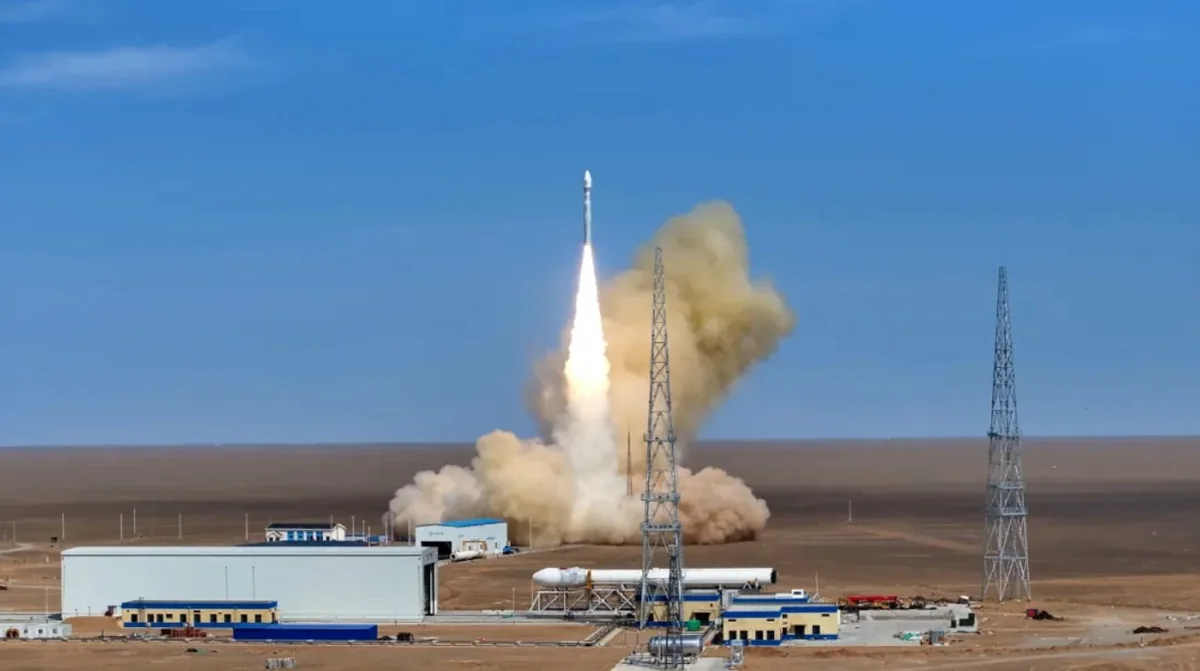
China completed six orbital launches in less than a week with a 100% success rate after a Kinetica-1 carrier rocket sent nine satellites into orbit on Sunday, Report informs via Global Times.
The Kinetica-1 Y18 lifted off at 12:03 pm from the Dongfeng commercial space innovation pilot zone in Northwest China. Its payloads included satellites for remote sensing, disaster prevention, scientific experiments, artificial intelligence computing and next-generation communications technologies.
The mission concluded a launch streak that began on September 15 and involved the Zhuque-2E, Gravity-1, Long March-12, Kuaizhou-11, Long March-2D and Kinetica-1 rockets.
The series also highlighted the growing role of commercial space companies in China's launch sector.
On September 15, LandSpace's Zhuque-2E Y7 rocket launched 10 satellites for the Qianfan, or Spacesail, mega-constellation. Less than 16 hours later, OrienSpace's Gravity-1 Y3 launched another eight Qianfan satellites. The two missions brought the number of Qianfan satellites launched to 256.
On September 17, a Long March-12 rocket launched the 25th group of China's low-orbit internet satellites, while a Kuaizhou-11 sent two commercial remote-sensing satellites into orbit. Two days later, a Long March-2D launched four PIESAT-2 synthetic aperture radar satellites developed by GalaxySpace.
Sunday's Kinetica-1 mission also carried several experimental satellites.
Among them was Chaozhisuan-1, equipped with a visible-light camera and an AI computer designed to process imagery and identify targets directly in orbit.
Another payload, Pengcheng-1, integrates a 5G non-terrestrial network base station and core network, onboard AI computing, laser communications and microwave communications. The satellite will be used to test technologies for next-generation satellite internet and integrated space-air-ground networks.