Baku 19° C
Damjan Jović: Serbia sees Azerbaijan as one of top strategic partners - INTERVIEW
- 03 April, 2026
- 11:00
Stay up to date with the top news!
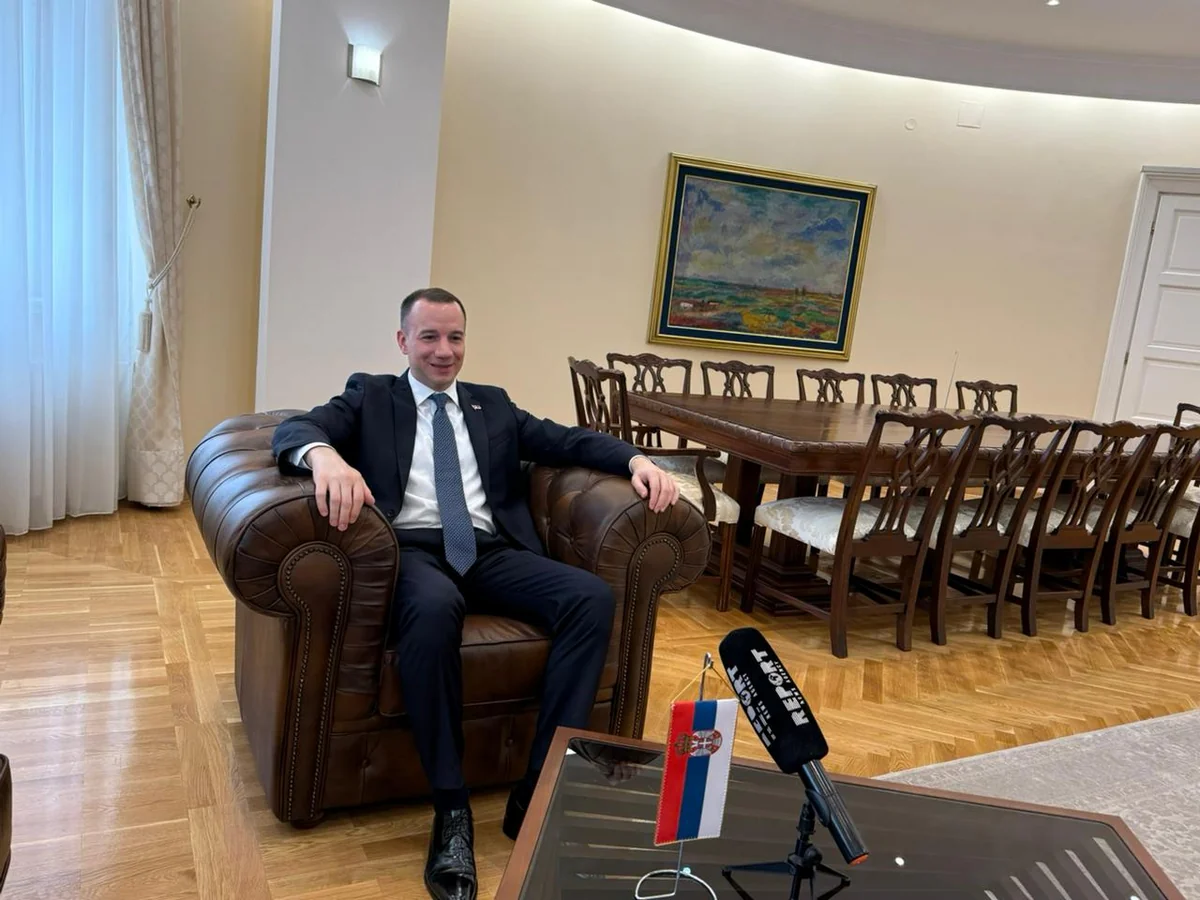
Secretary of State of the Serbian Ministry of Foreign Affairs, Damjan Jović, shared his views on the current state and prospective development directions of Azerbaijan-Serbia relations in an interview with Report's Balkan bureau.
He emphasized that although cooperation in the energy sector is a priority within the framework of strategic partnership, in recent years, relations between the two countries have also developed in the fields of economy, trade, defense industry, culture, and other areas.
The interview discussed the issue of energy security, Azerbaijan's role in Serbia's energy supply, SOCAR's projects, as well as the level of mutual investments and the impact of the direct air route to be launched in May on cooperation.
Mr. Jović, the strategic partnership between Serbia and Azerbaijan has significantly strengthened in recent years. What do you see as the future directions for the development of this cooperation?
In February this year, we had the honor of hosting the President of Azerbaijan, Ilham Aliyev, on the occasion of Serbia's Statehood Day. This was a great honor for us and a clear demonstration of the high level of respect shown by the Azerbaijani leader toward our people and our country. The visit contributed not only to friendly relations but also to further strengthening the ties between the two countries that maintain one of the closest levels of strategic partnership.
And this first session of the Strategic Partnership Council brought us some new agreements and memorandums that were signed, and this clearly defines the strategic path that we took from both sides in cooperation for the years to come. These agreements cover not only the energy sector, but also economic, trade, industrial cooperation, media, sports, culture, and other fields that are prospective for cooperation between our two countries. And this cooperation is advancing from year to year. We consider Azerbaijan as one of the friendliest countries in the world and one of the most important strategic partners to Serbia as well.
Energy security has become a critical issue for Europe. In this context, how do you assess Serbia's cooperation with Azerbaijan?
This cooperation in the energy sector is definitely significant for us. With the war in Ukraine, the energy supply of Europe and all European countries has become a challenging task for everyone. And thanks to very close relations between our two countries, we relied on Azerbaijan for our energy needs. This cooperation is developing very well at the moment.

I think we are importing about 500 million cubic meters of natural gas with the prospect to increase these imports up to 1 million. With the construction of this gas-fired power plant near Niš, these imports might go up to 1.5 million cubic meters, which is important for us, because it is diversifying the energy portfolio and energy supply of Serbia. We are looking forward to this cooperation.
The gas-fired power plant project near the city of Niš that you mentioned will be SOCAR's first major joint project in Serbia. In general, how do you assess SOCAR's activities in Serbia and the level of Azerbaijani investments?
Yes, this is the most important joint project between our two countries, definitely, because it is not only about supplying natural gas to Serbia, but it is long-term investment from our point of view and something that will, in the long run, align interests of our two countries, and this will be the best proof of strategic relation between the two countries.
How do you think-will energy remain the main driver of Azerbaijan–Serbia relations in the near future, or will cooperation transform toward other areas based on the documents signed during the recent visit?
The energy sector is extremely important; however, other areas are also being discussed. For example, the food safety memorandum that was signed opened up doors for the export of food products from Serbia to Azerbaijan, but also other sectors in trade, where we should definitely improve our relations. For example, the defense industry is cooperating very well between us. We are definitely satisfied with the cooperation in this field.
There is a lot of space to expand this cooperation, but also in people-to-people contacts and in cultural exchanges. Today, the co-chairs of the Intergovernmental Commission on cooperation between the two countries are individuals who pay special attention to the development of our relations.
We hope that, especially with the opening of direct flights to Baku by Air Serbia, the activity of business circles in both Belgrade and Baku will increase, providing a new positive impulse for the development of economic cooperation between our countries.
Are political consultations between the ministries of foreign affairs of Azerbaijan and Serbia planned to be held this year?
I think we have the most frequent political consultations between the two ministries. Since Minister Marko Đurić became a minister and I began serving as State Secretary at the ministry, political consultations between our countries have been held every year, which means in 2024 your representatives were in Belgrade, and last year I was in Baku. This year already, a colleague of mine, the other state secretary, Nevena Jovanović, visited Baku for multilateral consultations, and I expect to host your delegation by the end of this year, also here in Belgrade, for the next round of bilateral political consultations.
This is a good mechanism for the overview of everything that is going on on a bilateral basis between the two countries. We have a high level of understanding between our two ministries. As you know, we strongly support each other on issues of territorial integrity and sovereignty. These are very important principles for both of our countries. This level of understanding is not only at the level of partnership between the two countries, but it has also become friendly meetings of people who know each other very well. It is like meeting the closest friends.

We would also like to receive information about other topics on Serbia's agenda. Considering your experience in the EU accession negotiation process, at what stage is Serbia's integration into the European Union currently, and how does Belgrade define its main priorities in this direction?
As you know, Serbia is a candidate member state for membership in the EU. This process of your integration is sometimes going faster, sometimes slower. But in the last couple of years, it has become a bit frustrating for Serbia because, since the beginning of the war in Ukraine, this integration process has become less merit-based but much more politically measured. And as you know, Serbia has not only friendly but brotherly relations with both Ukraine and Russia, and we try to preserve good relations with both countries.
We are supporting territorial integrity and sovereignty of Ukraine, but at the same time, we are the only European country that has not introduced economic sanctions against the Russian Federation. This is something that most people in Brussels do not like, and this is why we have consequences on our EU integration process.
And also, I would say that there are some hypocrisies from some of the Western partners because their investors also invested in Serbia and built up their production facilities in Serbia because they had cheap inputs or cheaper energy that is coming from Russia to Serbia. So they also profited from these Serbian arrangements.
On the other side, at the same time, their governments are pressuring us to cut off energy cooperation with Russia. But no one actually offered a reliable alternative. And with this situation in the Middle East, the situation is becoming only more difficult for everyone in Europe and elsewhere. In this context, we are trying to have Serbian national interest as a priority and we are trying to preserve friendships and to have beneficial relations with all friendly countries in the world.
The second most complicated and difficult political issue for us in terms of European integration is the fact that we are strongly opposing the illegal and unilateral declaration of independence of Kosovo, which is our southern province and this is an issue where we have conflicting interests with some of the major European countries. So these two issues, our relation with the Russian Federation and also our position on the Kosovo issue, are something that is not in favor of accelerating our EU integration process.
We define the integration process as a strategic interest of Serbia, not because we are always impressed by the performance of the European Union, but because we are where we are geographically and about 70% of all foreign investments are coming from the EU countries. Also, 65% of all our exports are going to the European Union. We are trying to diversify this but at the moment, this is the reality.
The biggest challenge is how to balance our desire to economically develop our country and to preserve good relations with all major European countries and at the same time to preserve our position on the illegally and unilaterally declared independence of Kosovo that we do not recognize and we won't recognize in the future.
Also, the position of Serbian people who live in the territory of Kosovo and Metohija is very difficult. We hope that this situation will change in the future, that we will have more understanding from the major European partners, because this is definitely not something that is European standard in preserving the rights of people, something that we are witnessing at the moment in Kosovo and Metohija.

If I remember correctly, on March 18, a joint declaration on cooperation in the field of defense was signed between Albania, Kosovo, and Croatia.
Well, we definitely see this arrangement as directed against Serbia because we do not see a need for this kind of military alliance in the region, as this is not improving the stability of the region. Of course, we understand this in a very serious way and we will try to be prepared to respond to any challenge to our security and to the security of the Serbian people.
In general, how does Serbia contribute to maintaining regional stability against the backdrop of increasing geopolitical competition in the Western Balkans?
First of all, we were among the initiators of some of the major economic platforms to connect regional markets and countries from our region. You might remember the "Open Balkans" initiative that was aimed at creating a common market between Serbia, North Macedonia, Albania, free flow of workforce investments and capital and services between the three countries. It functioned quite well for a while, but then, when the European Union proclaimed that Albania and Montenegro are leaders in European integration, it seems that now Albania is losing interest in working more on open Balkans because they already see themselves as members of the EU.
And also, connectivity is very important. That is a field where we can improve situations a lot without good highways and other infrastructure that we are developing, also with our friends from Azerbaijan here in Serbia. I think there are no conditions for businesses to flourish and this is something that we are trying to explain to our neighbours from Bosnia, Montenegro, Croatia, and elsewhere.
Author