
 Baku 22° C
Berlian Helmy: Indonesia has identified 24 areas for cooperation with Azerbaijan - INTERVIEW
- 09 February, 2026
- 12:01

Stay up to date with the top news!
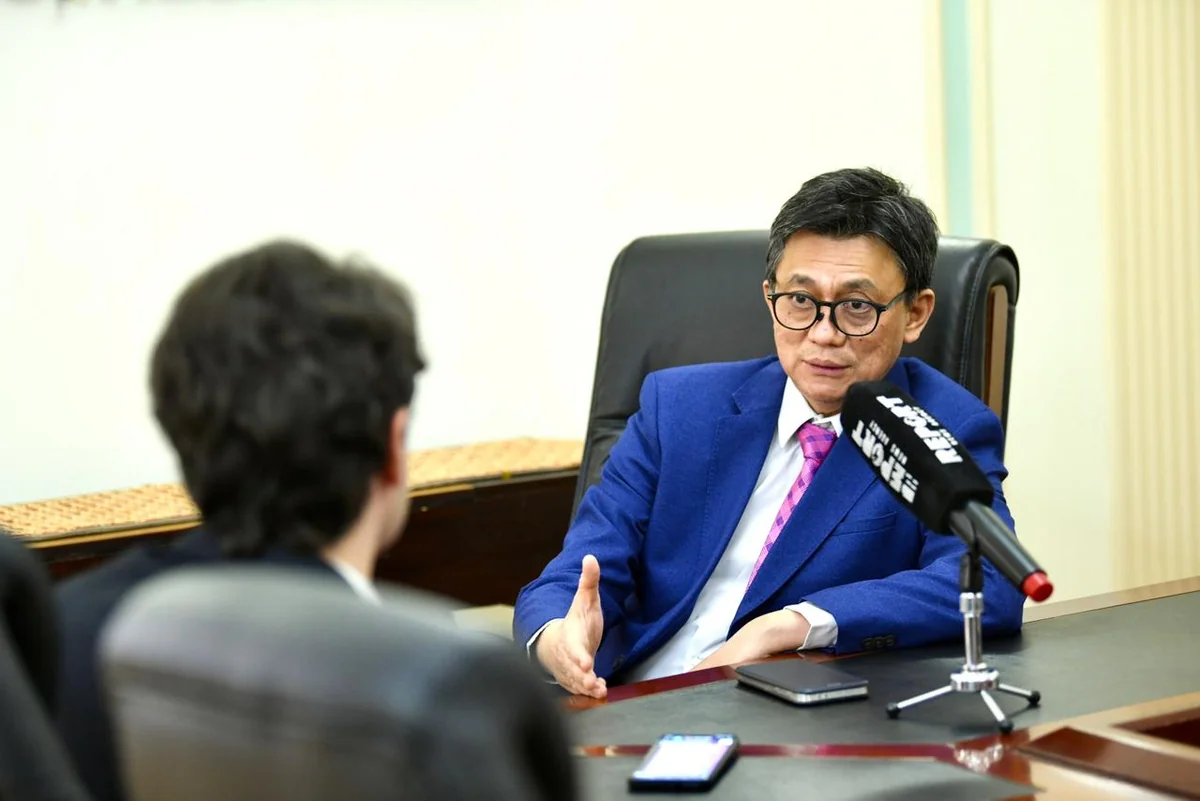
Azerbaijani–Indonesian relations have a long history. Today, bilateral ties are reaching a new level. Azerbaijan's accession to the Developing Eight (D-8) Organization for Economic Cooperation is giving impetus not only to the development of political relations but also to economic ties. In this context, Baku and Jakarta are discussing issues related to further strengthening cooperation in the political and economic spheres, mutual investment, and the expansion of business contacts. In an interview with Report, Indonesia's Ambassador to Azerbaijan, Berlian Helmy, spoke about plans for the development of bilateral relations and goals for 2026. On January 30 this year, he presented his credentials to the President of Azerbaijan, Ilham Aliyev.
- Azerbaijan and Indonesia established diplomatic relations in 1992. How do you assess the current level of political dialogue between our countries, and what strategic steps are planned for 2026 and the years ahead?
- I would divide relations between Indonesia and Azerbaijan into two stages.
The first stage was the establishment of diplomatic relations. This period reflected our readiness and strong political will to build close ties with partners around the world. Today, we view Azerbaijan as a dynamically developing country in the Caucasus region, located at the strategic crossroads of Asia and Europe. This geographical position makes Azerbaijan an important partner for Indonesia and creates opportunities for cooperation across a wide range of sectors.
As Indonesia seeks to expand its circle of reliable partners, and Azerbaijan is one of the most dynamic countries in the region, we pursued closer engagement and the development of bilateral relations from the outset.
The second stage marks a transition to a new level of diplomatic relations. At this point, we are building on the accumulated momentum to make bilateral ties more fruitful, productive and mutually beneficial for both countries.
Accordingly, we are focusing on the development of promising and mutually advantageous areas of cooperation. A key element in this process is political capital, which enables us to strengthen relations and ensure their long-term sustainability.
We therefore plan to establish a solid political foundation as the formal basis for further cooperation. In this context, the creation of a bilateral infrastructure for interaction is essential. The model of cooperation should be comprehensive, integrated and holistic, implying not one-off initiatives but systematic and repeated engagement with a multiplicative effect.

In parallel, we intend to launch new areas of cooperation, while expanding and deepening existing formats and involving an increasing number of sectors in the bilateral agenda.
At the present stage, therefore, Indonesia and Azerbaijan need to build a comprehensive and strategic partnership. This represents a long-term philosophy of strategic cooperation that will serve as the foundation for the sustainable and mutually beneficial development of bilateral relations.
- Azerbaijan is a member of the Developing Eight (D-8) Organization. How do Azerbaijan and Indonesia plan to cooperate within this framework?
- The D-8 can be viewed as an intermediate format that makes it possible to structure and link the key parameters of interaction between our countries. This involves several interconnected elements that are important for the development of cooperation.
The first of these is mutual understanding. We must clearly understand each other's needs and ensure compatibility and complementarity of interests, whereby the needs of one side can be met by the advantages of the other.
The second element is the presence of a political instrument that supports economic and social partnership and is based on strong political will on the part of both governments. This is an essential prerequisite for sustainable cooperation.
The third aspect is social and cultural interaction aimed at the transfer of knowledge from generation to generation. We are talking about a future that belongs not only to the current generation, but also to our children and grandchildren. This is why the sustainability of the partnership is of key importance. Social and cultural ties play a significant role in shaping long-term relations and represent an effective model of cooperation for future generations.
At the same time, the existing mechanisms are insufficient. At present, we have a bilateral forum for political consultations, but this format alone is no longer enough for the full development of cooperation.

There is a need to create additional mechanisms, primarily in the areas of the economy, investment, tourism, social policy, culture and education. As a next step, the establishment of a joint commission, an intergovernmental working group, as well as specialised sectoral groups, is being proposed.
In addition, a broader system of intergovernmental ties is required, covering the widest possible range of areas of cooperation. Such a mechanism should complement the existing format of political consultations and ensure a comprehensive approach to the development of bilateral relations.
- Do you consider it necessary to intensify bilateral relations, including in the economic and political spheres, as well as high-level contacts?
- Yes, absolutely. And for this we are counting on contacts between the leaders of the two countries.
Indonesia has one of the largest economies, a developed industrial base, and significant natural resources, including in nickel mining, as well as substantial human capital. It is one of the most populous countries in the region. At the same time, our countries share a number of similarities: both Indonesia and Azerbaijan are Muslim but secular states, where religion is separated from the state. In addition, Indonesia has traditionally shown strong interest in developing economic ties with its partners.
As for economic relations with Azerbaijan, we are discussing the current dynamics of bilateral trade, the potential for mutual investment, priority areas of cooperation, as well as practical formats of engagement, including the organisation of business forums and possible larger-scale initiatives.
- How can the two sides build mutually beneficial economic cooperation?
- In answering this question, I would like to look at the situation from the perspective of different levels.
The first level is G2G, that is, "government-to-government" interaction. At the G2G level, it is necessary to establish a strong foundational framework for partnership that covers all interconnected and mutually beneficial sectors of cooperation. At this stage, policy consolidation, alignment and adjustment between the governments of Indonesia and Azerbaijan are required.

Without the coordination of overall policy and the development of consolidated approaches, it will be impossible to meet mutual interests - such a format simply will not work.
This is followed by the second level, B2B, that is, "business-to-business" interaction, as well as a broader societal level. In this context, society refers not only to entrepreneurs, but also to non-state actors, including think tanks, experts, the academic community and other stakeholders. This forms a kind of second track of interaction - more flexible, accessible and less formalised.
When there are solid agreements at the G2G level and strong political commitments on both sides, these arrangements become a full guarantee of effective engagement at the non-governmental level.
It is precisely this second level that makes cooperation simpler, more accessible and more practice-oriented.
- Which economic sectors do you consider the most attractive for cooperation between our countries?
- In my assessment, there are 24 highly promising sectors in which Indonesia and Azerbaijan can actively develop investment, business, trade and other forms of cooperation. These areas need to be explored and launched as soon as possible.
Among the top priorities are oil and gas, including joint exploration, production and processing, as well as green energy and renewable energy sources.
Then comes agriculture - not only cultivation and production, but also modern agrotechnologies, fisheries, and the transfer of vessel monitoring technologies.
There is significant potential in housing construction. In Indonesia, around three million housing units are built each year, and we see opportunities for mutual investment by companies from both countries, for example in Nakhchivan or other regions of Azerbaijan.
Telecommunications, low-orbit satellites, and digital infrastructure - including fibre-optic networks and the expansion of mobile coverage - are also among the priorities.
In addition, we can single out pharmaceuticals, that is the joint development of medicines, including those based on herbal raw materials, as well as healthcare more broadly - the exchange of experience in system management and in combating diseases, including lessons learned from the COVID-19 pandemic. We have already begun discussions on the exchange of medical specialists and students. At present, only one Indonesian medical student is studying at Azerbaijan Medical University. I recently met with Health Minister Teymur Musayev and proposed opening more opportunities for Indonesian students, an idea he supported.
Joint research and development in pharmaceuticals and vaccines, automotive manufacturing, and industrial technologies of the fourth industrial revolution, including electric vehicles, are also important areas. We are ready to bring Indonesian manufacturers to the Azerbaijani market with full after-sales service.
Mutual trade remains limited, but the potential is enormous. When presenting my credentials, I proposed to President Ilham Aliyev that a limited preferential trade agreement be considered in order to accelerate bilateral trade. The head of state responded positively to this proposal. Next week (the interview was conducted on February 6 – ed.), I am meeting with Economy Minister Mikayil Jabbarov specifically to discuss this issue. We see that consumer goods from Indonesia could be highly competitive on the Azerbaijani market.
Another promising area of cooperation is food security. This includes supplies of Azerbaijani fertilisers to Indonesia, investments in processing facilities in Indonesia, and, in the opposite direction, Indonesian investments in agro-plantations in Azerbaijan, as well as the supply and servicing of modern agricultural equipment.
Tourism is one of the most promising sectors. We have already signed an agreement on halal tourism. The key task now is to improve accessibility: direct flights, visas, tourist packages and so on. Yesterday (February 5 – ed.), I met with the Chairman of the State Tourism Agency, Fuad Naghiyev, and proposed several options for air connectivity: a direct Azerbaijan Airlines flight to Jakarta or Bali, code-sharing arrangements with Turkish Airlines and Garuda Indonesia, or flights via transit hubs. I also suggested concluding a general aviation agreement as a first step towards launching direct flights.
A convenient electronic visa on arrival is already available for Azerbaijani tourists travelling to Indonesia. In the longer term, I hope we can move towards a visa-free regime. This will be discussed during bilateral consultations and possibly during talks between the leaders.
Another important idea, which has received support from the Azerbaijani leadership, is to include Baku in umrah travel packages for Indonesian pilgrims, either before or after Jeddah. This could significantly increase the flow of Indonesian tourists, and we are fully prepared to work on this initiative.
Joint promotion of tourism is also needed through gastronomic, historical, religious, natural and maritime routes, as well as various festivals and cultural exhibitions.
Finally, there are defence technologies. Indonesia is actively developing this sector, and Azerbaijan is doing the same. We are ready to offer cooperation in technology transfer, joint research, innovation and possibly joint exercises. There are no specific documents at this stage, but I plan to meet with the defence minister to discuss this initiative.
As I have said, overall, there are around two and a half dozen such promising areas. The key task now is to await the crucial high-level meetings.
- What about plans in the field of education?
- Education is the foundation of the future. We propose close cooperation between universities, including student and faculty exchanges, scholarships, and joint research and publications, with a particular focus on STEM - science, technology, engineering and mathematics - including artificial intelligence, data analytics, the Internet of Things and digital literacy. Cultural cooperation is also extremely important: memoranda of understanding, exchanges of artists and festivals, so that our peoples can better understand each other's cultures.
- Azerbaijan will host the 13th session of the World Urban Forum (WUF13) this year. Does Indonesia plan to take part in its work, including the Leaders" Summit?
- Indonesian President Prabowo Subianto may visit Azerbaijan in May to participate in the World Urban Forum.
Photo