Baku 23° C
Elisabetta Falcetti: EBRD ready to participate in long-term financing of transport projects in Azerbaijan - INTERVIEW
- 13 May, 2026
- 12:14
Stay up to date with the top news!
The current map of international transport and energy routes is undergoing fundamental changes, with Azerbaijan transforming from a regional player into an indispensable link between East and West. The development of the Middle Corridor, the digital transformation of customs systems, and ambitious green energy projects are becoming the foundation for long-term stability not only in the Caucasus but throughout Europe. In these processes, the European Bank for Reconstruction and Development (EBRD) is acting not simply as a financial institution but as a strategic architect supporting the modernization of critical infrastructure.
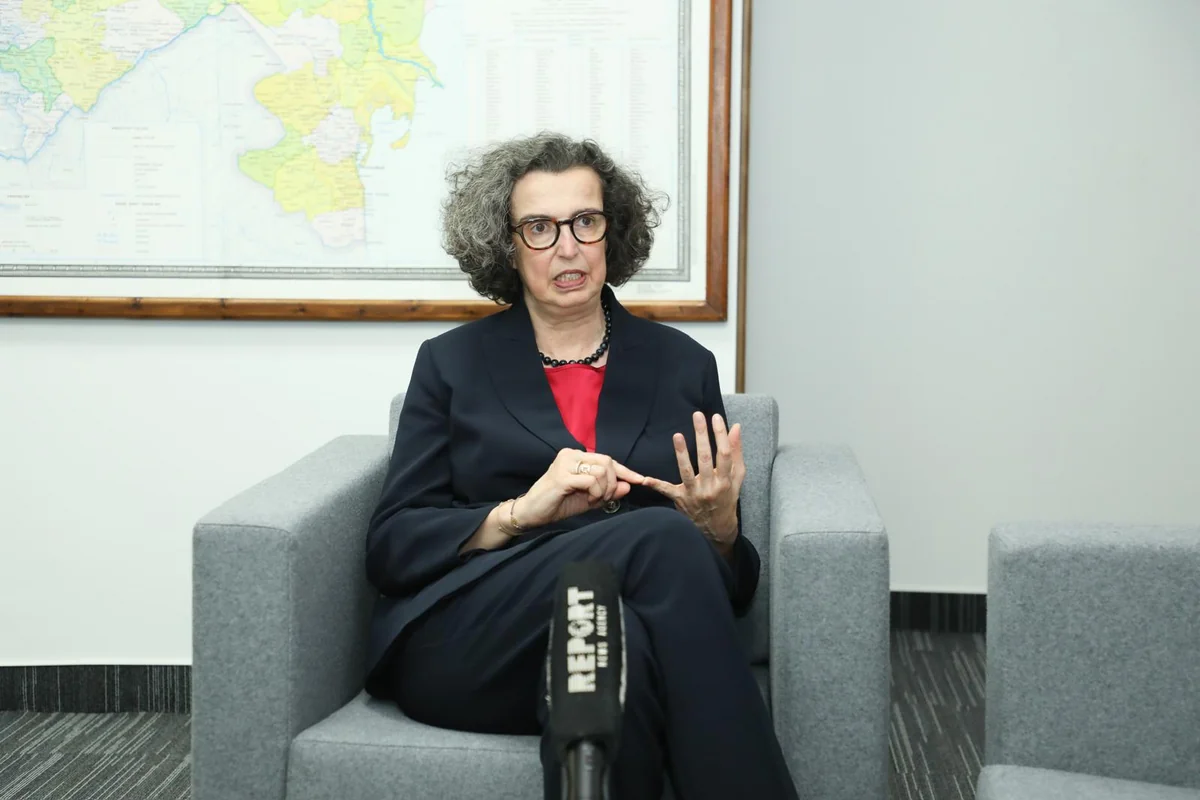
In an exclusive interview with Report, Elisabetta Falcetti, EBRD Managing Director for Türkiye and the Caucasus, discussed the prospects for the rehabilitation of railways in Nakhchivan, investments in green cities in Azerbaijan, and how the country can become a key exporter of renewable electricity to the EU.
Report presents the interview:
- As far as I know, this is your second visit to Baku, and I hope it was productive. We know you had meetings with private and public sector partners. What was on your agenda? Please tell us about your meetings here and your key takeaways.
- Thank you. It is always a pleasure to be back in Baku. Every time I visit, I am struck by how much the city continues to evolve. There is an atmosphere of energy and ambition here, which I find very refreshing. I am also grateful to our Azerbaijani hosts and partners for the openness and substance of our discussions.
During this visit, we met with a broad range of public-sector counterparts, including Ministries of Economy, Finance, Energy and the Ministry of Digital Development and Transport, as well as the Azerbaijan State Water Resources Agency.
Our agenda reflected the breadth of the EBRD's engagement in the country: regional connectivity, including transport, energy and digital links; the Middle Corridor and TRIPP; support for business in Baku and in the regions; renewables; water and wastewater infrastructure; and potential urban regeneration opportunities.

My key takeaway is that Azerbaijan is ready to seize the opportunity to build on its strategic location, its growing role as a connectivity hub and its significant clean energy potential. We've been investing here since 1992 and we remain as committed as ever to supporting Azerbaijan's growth agenda that now rightly focuses on stronger regional integration, economic diversification and energy transition.
- Azerbaijan currently positions itself as a key transit and logistics hub for the Middle Corridor. How do you assess the country's current role in the regional transport architecture and its potential over the coming years?
- Azerbaijan"s strategic location gives it a natural role as a trade and investment hub along the Middle Corridor. The country sits at the intersection of important East-West routes and this is critically relevant today, as companies and governments look for more resilient, diversified and efficient connections between Asia and Europe.
The Port of Baku, rail links, road infrastructure and digital systems all can have an important role to play. But the full potential will only be realised if these assets are integrated into a comprehensive framework that allows goods to move smoothly across maritime, rail and land infrastructure. That also requires a strong policy and digital backbone, including better coordination of container movements and logistics systems.
This is where the EBRD can add value. We have supported transport and connectivity investments across the wider region, including in Kazakhstan, Uzbekistan and the Kyrgyz Republic, and our work on Central Asian transport connections identified both hard infrastructure investment needs and soft connectivity measures. We are keen to bring the same practical, investment-led approach to Azerbaijan and its neighbours.
- The EBRD recently allocated funds to develop railway infrastructure in Türkiye to eliminate corridor bottlenecks. Is the Bank considering similar large-scale projects in Azerbaijan, such as expanding the capacity of the Port of Baku or modernising railway routes, including the connection to Nakhchivan, as early as 2026?
- We are very interested in supporting strategic connectivity investments in Azerbaijan where they are economically sound, sustainable and aligned with the country's long-term priorities. Azerbaijan already plays an important role and further improvements to port, rail and logistics are certainly the only way forward.
On Nakhchivan specifically, following the high-level agreement between the EU and the Government, we have agreed to support the preparation of a feasibility study for the rehabilitation of the Nakhchivan railways. Preparatory work is already underway, and the assessments are expected to start soon. Once the study is completed, we will work with the Ministry to explore the best financing options for implementation, potentially involving the EBRD and other international financial institutions.

It would be premature to announce specific financing at this stage, including for 2026. Our approach is to first ensure that projects are technically, economically, environmentally and socially sound. Once that foundation is in place, the EBRD can bring long-term financing, technical expertise and the ability to mobilise other partners.
- Regarding regional transport connectivity, the Zangazur Corridor project is a significant topic of discussion. How does the EBRD assess the economic feasibility of this route, and is the Bank prepared to consider participating in its development?
- We welcome steps that strengthen regional connectivity and contribute to lasting peace. Cross-border initiatives, including the US-backed TRIPP framework, could give the Middle Corridor a timely impulse to transform into a game-changing route between Asia and Europe, while also supporting trade, investor confidence and economic growth across the South Caucasus.
From an EBRD perspective, the economic feasibility of any corridor depends on a number of factors: expected traffic volumes, integration with existing transport networks, interoperability, governance arrangements, environmental and social standards, and the broader policy framework. These elements need to be carefully assessed before any large-scale investment decision is made.
The EBRD is well placed to support such work. We are active in Azerbaijan, Armenia and Türkiye, which allows us to look at infrastructure not only as separate national segments, but as part of a single economic and technical corridor.
- The EBRD intends to allocate up to €5 billion in 2026 to support economies impacted by the Middle East conflict. What portion of these funds could potentially be directed toward Azerbaijan, and which sectors are prioritised: energy, food security, or SME support?
- The EBRD's Middle East Conflict Response framework is designed to deploy up to €5 billion in 2026 across affected economies, including Jordan, Lebanon, the West Bank and Gaza, Iraq and neighbouring countries such as Armenia, Egypt, Türkiye and Azerbaijan.
For Azerbaijan, we are closely monitoring potential risks and spillovers. Our role as a counter-cyclical bank is to support clients and partners in moments of stress, particularly when other sources of finance become more constrained. Our major strength is that we are close to our clients on the ground, which gives us an early view of emerging risks and allows us to respond quickly where needed.
Our measures in Azerbaijan could include ensuring access to finance for trade and investment, for example, through the Trade Facilitation Program, and continued engagement with partner banks as well as corporates, particularly in the SME segment.
At the same time, we see strong potential to support energy resilience and diversification, including through investments that accelerate energy transition via battery energy storage systems (BESS) and grid resilience measures.
- One of the key areas of assistance is the stabilisation of the financial sector. Does the EBRD see a need to expand credit lines for Azerbaijani banks to maintain their liquidity amidst volatility in neighbouring regions?
- At this stage, we understand that the Azerbaijani banking sector is generally in a good position. The regulator has played an important and constructive role in recent years, helping to build strong capital and liquidity buffers and supporting the implementation of internationally recognised standards. This fills us with confidence in the sector's resilience and suggests that there is currently no objective need for liquidity support.
That said, we remain actively engaged with Azerbaijani banks. Our focus is on areas where the EBRD can bring clear additionality: MSME finance, green lending, inclusive finance and trade finance. These are important not only for financial sector development, but also for the wider diversification of the economy.
A recent example is our $20 million loan to AccessBank for on-lending to micro, small and medium-sized enterprises owned or led by young entrepreneurs. This reflects the kind of targeted support we want to provide - helping banks reach underserved segments of the economy while strengthening resilience and opportunity.
- Baku is hosting the World Urban Forum next month. With Ganja now a full member of your Green Cities program, are other cities following suit? What's the current state of play for EBRD Green Cities in Azerbaijan?
- Azerbaijan is an important part of the EBRD Green Cities agenda. In Ganja, we helped develop the Green City Action Plan, a long-term strategy to make the country's second-largest city healthier, more sustainable and more liveable. We are also supporting priority investments in solid waste management, street lighting and water infrastructure.

The program is now moving from planning to implementation. Following the signing of the first €35 million loan, we are preparing a second €120 million loan to improve water and wastewater infrastructure in Ganja. The total investment program is estimated at around €410 million, which shows the scale of ambition behind this work.
We are also planning to finance sustainable infrastructure beyond Ganja. In Shaki, for example, we plan to sign a €91 million loan this year for the construction and rehabilitation of water, wastewater and stormwater infrastructure.
In Baku and the Absheron Peninsula, we have started a feasibility study to improve water supply for more than 3 million people. We are also exploring how the Bank could support urban regeneration in legacy pollution sites in Baku, turning environmentally damaged areas into healthier and more attractive spaces for communities and local investments.
- In your view, what role can Azerbaijan play in ensuring Europe's energy security, specifically through the export of renewable electricity?
- Azerbaijan already plays an important role in regional energy security. For decades now, the country has been Europe's reliable energy partner. Now, we see that Azerbaijan aims to take this partnership one step further – this time to become a reliable green energy partner for Europe.
At the EBRD, we see ourselves as a strong partner in this transition and stand ready to support Azerbaijan in achieving its renewable energy potential.
But this is a very complex undertaking as exporting renewable energy will require greater scale, bankable cross-border infrastructure and regulatory alignment. For this to materialise, Azerbaijan will need to move towards a multi-gigawatt pipeline sooner rather than later.
Author

Photo