Baku 22° C
Foreign media digest following US, Azerbaijan and Armenia leaders' summit in Washington
- 11 August, 2025
- 13:18
Stay up to date with the top news!
In recent days, the global media have been actively discussing the historic event in Washington, where the leaders of the US, Azerbaijan, and Armenia met on August 8, 2025.
During the meeting, documents were signed aimed at normalizing relations between Baku and Yerevan. According to foreign media, this summit was an important step in resolving the long-standing conflict in the South Caucasus, drew attention to a new transport route, and sparked discussions about reducing Russia's influence in the region.
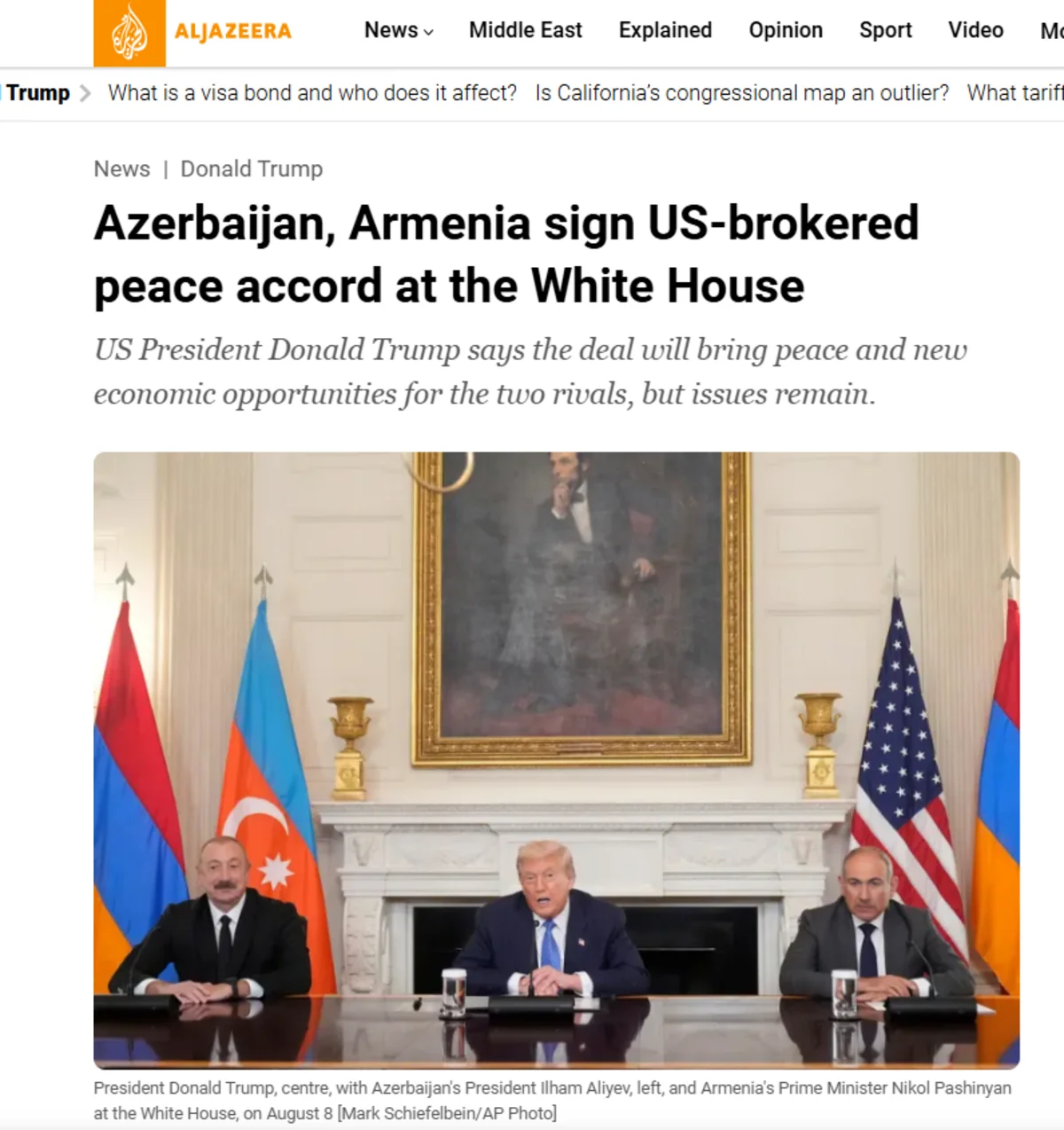
Al Jazeera emphasizes that the initialing of the peace agreement between Azerbaijan and Armenia, mediated by US President Donald Trump, marks a turning point for the South Caucasus. The agreement not only ends decades of conflict, but also opens up new opportunities for regional trade and cooperation, the publication notes, focusing on the creation of the Zangazur Corridor, which will connect the main territory of Azerbaijan with Nakhchivan through Armenia. Al Jazeera also points out that the participation of the United States as a mediator underscores Washington's desire to strengthen its position in the region, traditionally considered a zone of Russian interests.
CNN highlights Donald Trump's role in achieving this agreement. Trump, who called the agreement historic, also received praise from leaders of both countries, who suggested nominating him for the Nobel Peace Prize, the channel says. CNN quotes President Ilham Aliyev as saying, Trump has done what other leaders have failed to do for decades, and emphasizes that the agreement includes provisions on mutual recognition of sovereignty and territorial integrity, as well as on the development of economic cooperation.
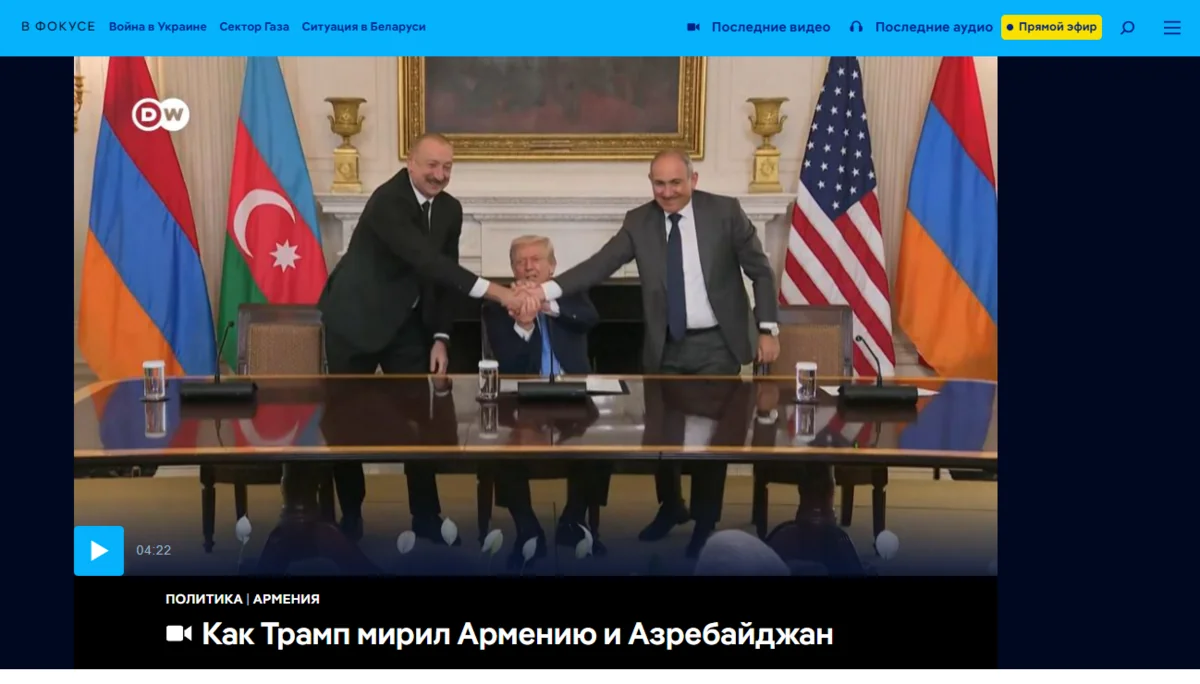
Deutsche Welle (DW) focuses on the economic prospects of the region, indicating that the Trump Route will become part of the wider Middle Corridor linking China, Central Asia and Europe via the South Caucasus. For Azerbaijan, this means strengthening its position as an energy and transport hub, and for Armenia, a chance for economic diversification and integration into international trade, DW notes. The newspaper also emphasizes that Russia’s absence from the signing process signals a significant weakening of its position in the South Caucasus, especially after its failures in mediation in previous years.
The Times of India notes that the creation of the Trump Route not only promotes peace between Armenia and Azerbaijan, but also opens up new trade routes that bypass Russia and Iran. The newspaper also emphasizes that the success of the talks was made possible by concessions by Armenian Prime Minister Nikol Pashinyan, who sought to normalize relations with his neighbors despite domestic protests in Armenia.
The Financial Times focused on the investment potential of the agreement, emphasizing that the opening of the Zangazur Corridor creates new opportunities for international corporations. The South Caucasus, long considered a risk zone due to conflict, may now become an attractive market for infrastructure projects, the newspaper writes. The publication notes that American companies that received exclusive rights to manage the corridor are already planning investments in modernizing railways and building new logistics centers, which could attract capital from Europe and Asia.
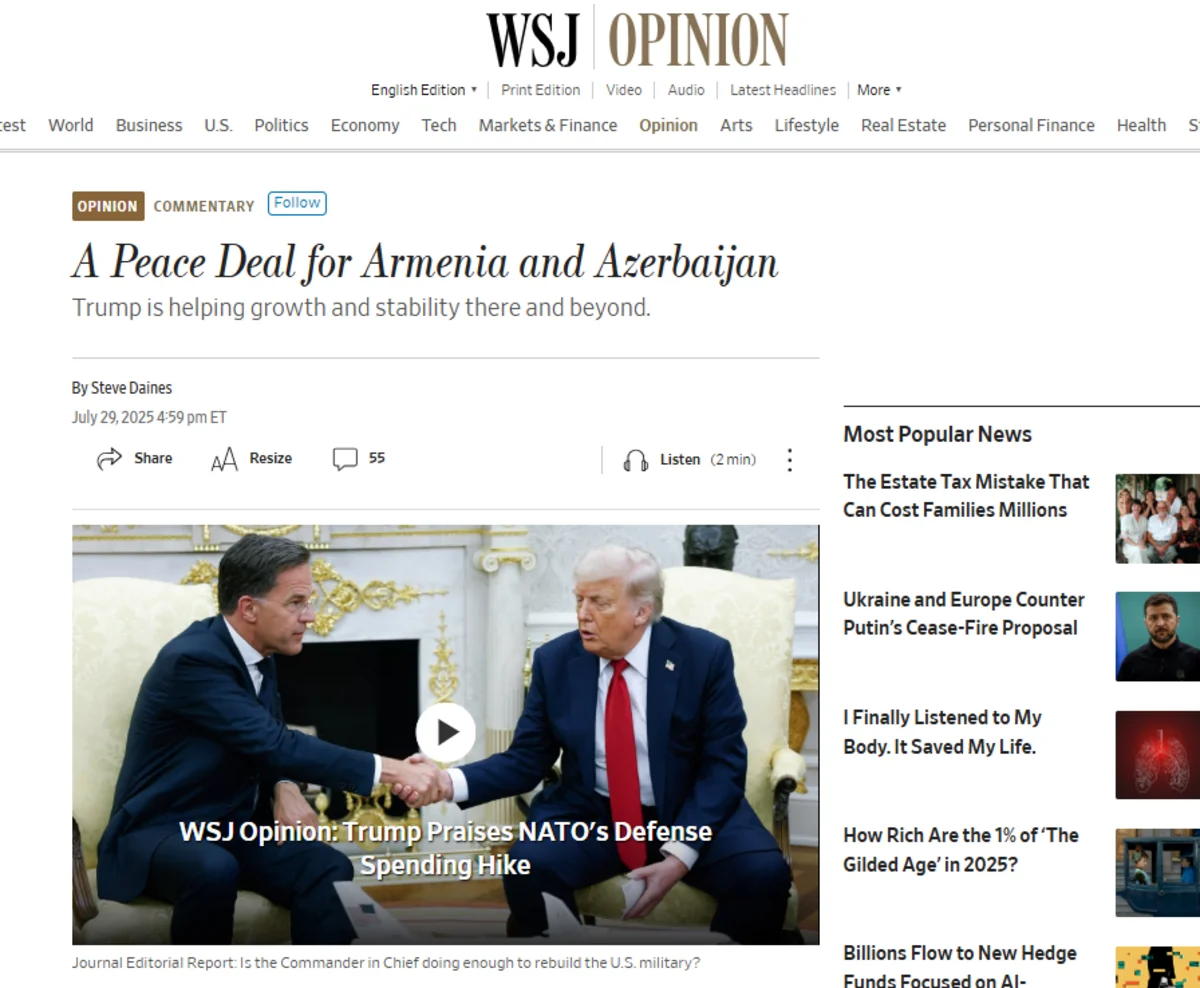
The Wall Street Journal examines the agreements through the prism of Europe’s energy security. The Trump Route strengthens Azerbaijan’s role as a key supplier of gas to Europe, especially in the context of the global transition from Russian energy resources, the newspaper notes. The newspaper focuses on how the new corridor connecting Azerbaijan with Nakhchivan and Türkiye could help increase gas supplies from the Caspian region, reducing the EU’s dependence on alternative sources.
The Japan Times views the summit’s outcome as part of a global competition for control over trade routes. The Zangazur Corridor will become a link in the Middle Corridor, which could compete with China’s Belt and Road Initiative, the newspaper writes. The Japan Times notes that Japan, as a major investor in infrastructure projects in Central Asia, views the agreement as an opportunity to participate in the development of the South Caucasus, especially in the construction of high-speed railways.
The Sydney Morning Herald considers the environmental prospects associated with the development of the transport corridor. The creation of the ‘Trump Route’ could promote the introduction of green technologies in the region, especially in transport infrastructure, the newspaper notes. The newspaper emphasizes that the American route operators have committed to using energy-efficient technologies and solar panels to power the logistics centers, which meets global climate goals.
Haaretz analyzes the agreement from a regional security perspective, emphasizing that it reduces the likelihood of escalation of conflicts on the borders. Haaretz also notes that Israel, as a defense partner of Azerbaijan, welcomes the agreement, seeing it as an opportunity to expand cooperation in cybersecurity and technology.

Author