Baku 22° C
Ambassador: Jordan hoping to gain access to Caucasus, Central Asian markets through Azerbaijan - INTERVIEW
- 06 February, 2026
- 14:08
Stay up to date with the top news!
Bilateral relations between Azerbaijan and Jordan continue to strengthen amid active political dialogue and expanding economic cooperation. In 2025, the countries made significant progress in establishing an institutional platform for cooperation, signing a set of key agreements in trade, economic, customs, tourism, and other areas, reflecting their mutual desire to deepen their partnership based on friendship and mutual respect.
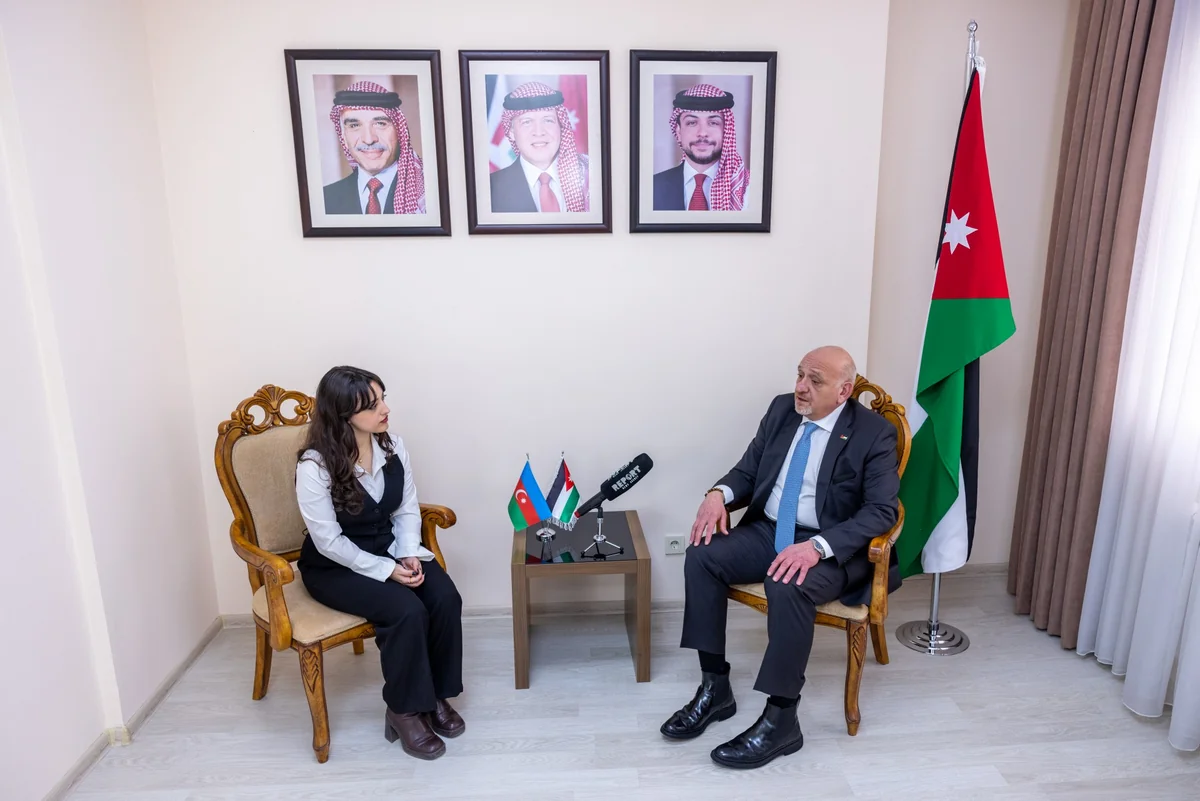
In an exclusive interview with Report, Jordanian Ambassador to Azerbaijan Omar Barakat Al Nahar discussed the development of relations in 2025, the initiatives that have shaped the new cooperation agenda, and the tasks and joint projects the parties plan to implement in 2026 in the political, economic, and cultural spheres.
- How would you characterize the results of cooperation between Azerbaijan and Jordan in 2025, and what tasks and goals have been set for 2026? Are mutual visits of government delegations from Azerbaijan to Jordan and from Jordan to Azerbaijan planned for this year?
- The year 2025 marked a watershed moment in Azerbaijan-Jordan bilateral relations, characterized by substantive institutional progress and strategic alignment across multiple sectors. The fourth meeting of the Intergovernmental Commission on Trade, Economic, and Technical Cooperation, held in Baku on November 27, 2025, served as the cornerstone achievement, producing six landmark agreements that significantly expanded the legal framework governing bilateral ties.
Among the most consequential outcomes was the signing of the Executive Cooperation Program for 2025-2027, ratified by His Excellency President Ilham Aliyev on January 5, 2026, which establishes comprehensive collaboration across science and education, culture and arts, youth and sports, archaeology, healthcare, and media. This programmatic approach provides institutional predictability and creates measurable benchmarks for cooperation. The customs cooperation agreement, which entered the ratification process in the Milli Majlis on February 2, 2026, represents another critical achievement, facilitating trade flows, streamlining customs procedures, and establishing mechanisms to combat customs-related offenses.
The bilateral legal architecture has evolved considerably. We have more than 40 documents that are now in force, eight agreements have reached expert-level consensus, and 12 new projects remain under active negotiation as presented at the fourth session.
This progressive layering of agreements demonstrates not merely diplomatic activity but sustained commitment to translating high-level political dialogue into operational cooperation. The signing of a Memorandum of Understanding between Azerbaijan's State Tourism Agency and Jordan's Ministry of Tourism and Antiquities, accompanied by an implementation program, signals a concrete intent to develop people-to-people connectivity, evidenced by the 49.9 percent increase in Jordanian tourist arrivals to Azerbaijan in 2025.
The 2026 agenda should center on implementation and expansion. The 12 projects currently under negotiation span pharmaceuticals, energy, digitalization, transport logistics, and investment cooperation. These are sectors that align with Azerbaijan's national priorities for economic diversification and Jordan's strategic positioning as a regional economic hub. The institutional framework established through the 2025-2027 cooperation program creates annual implementation milestones, requiring coordinated action across ministries and agencies to translate agreements into tangible outcomes.
A strategic priority involves operationalizing the recently signed agreements: the customs cooperation framework must be implemented through technical protocols, the tourism cooperation program requires joint marketing initiatives and visa facilitation measures, and the SME cooperation memorandum between KOBIA and JEDCO necessitates identification of specific sectors for entrepreneurial collaboration. Finance Minister Sahil Babayev emphasized during the commission meeting that these agreements will "define the medium-term agenda and help strengthen institutional ties between the ministries and agencies of the two countries."
The operational demands of the 2025-2027 cooperation program strongly suggest reciprocal high-level visits are under consideration. The proposed joint business forum in Amman, put forward by Jordan during the November commission meeting, would logically necessitate senior-level Azerbaijani business and government participation. Additionally, Azerbaijan's hosting of the World Urban Forum (WUF13) in May 2026 presents a natural opportunity for Jordanian ministerial-level representation, particularly given Jordan's expertise in urban development and the forum's significance as the premier global conference on urbanization.
The institutional rhythm established through regular intergovernmental commission sessions and the operational requirements of implementing recently signed agreements indicate that 2026 will most likely witness sustained high-level engagement.
- What work are the parties carrying out to expand bilateral trade between Azerbaijan and Jordan? Are inter-ministerial consultations and a session of the intergovernmental commission planned for this year?
- Bilateral trade expansion remains a strategic priority acknowledged by both governments, with ministers explicitly recognizing that current trade volumes remain substantially below the economic potential that exists between the two brotherly countries. The November 2025 intergovernmental commission meeting addressed this gap through three interconnected mechanisms: enhancing the legal and institutional framework for trade, removing procedural barriers, and creating sector-specific cooperation platforms.
The customs cooperation agreement, signed on November 27, 2025, and ratified by Azerbaijan's parliament on February 2, 2026, constitutes the foundational instrument for trade expansion. This agreement establishes mutual assistance protocols between customs authorities, facilitating the proper application of customs legislation and creating mechanisms to prevent, detect, and investigate violations. Article 22 of the agreement includes provisions for information exchange, voluntary assistance, technical cooperation, controlled shipments, confidentiality protocols, and procedures for executing assistance requests. By reducing customs processing times and enhancing transparency, this framework directly addresses friction costs that have historically constrained trade flows.
For Jordan, this agreement positions Azerbaijan as a strategic gateway to Commonwealth of Independent States (CIS) markets, as emphasized by the Jordanian Minister of Industry, Trade, and Supply, Yarub Qudah, who stated that Jordan views Azerbaijan as a "vital hub for expanding CIS trade." This strategic positioning creates reciprocal value: Jordan gains access to CIS markets, while Azerbaijan benefits from Jordan's established trade relationships across the Middle East and the North African region.
In addition to the Memorandum of Understanding signed between Azerbaijan's Small and Medium Business Development Agency (KOBIA) and Jordan Enterprise Development Corporation (JEDCO) on November 27, 2025, which establishes a crucial mechanism for bottom-up trade development. Unlike large-scale government-to-government contracts, SME cooperation creates distributed commercial relationships across diverse sectors. This framework will likely facilitate business matchmaking, provide market intelligence to entrepreneurs in both countries, and potentially establish co-investment mechanisms.
The sectors identified as most promising for trade expansion in the near term include pharmaceuticals, agriculture and food products, tourism-related trade, and, of course, ICT.
Finance Minister Sahil Babayev's invitation to Jordan to "actively participate in the expanding trade and transport cooperation in the region" reflects Azerbaijan's strategic positioning within the Middle Corridor and Trans-Caspian International Transport Route. For Jordanian businesses seeking to access Central Asian and Caucasus markets, Azerbaijan's transport infrastructure, including ALAT Free Economic Zone, the Baku International Sea Trade Port, railway connections, and air cargo facilities, provides logistical access that has been historically limited.
The intergovernmental commission operates as the principal institutional platform for bilateral economic cooperation, co-chaired by Azerbaijan's Minister of Finance and Jordan's Minister of Industry, Trade, and Supply. The fifth commission session dates shall be agreed upon on an annual or biennial meeting cycle through diplomatic channels.
The proposed joint business forum in Amman, while not a government commission session, would provide a complementary platform for private-sector engagement and could logically have an impact on progress to ensure government policies align with business community needs.
- In May 2026, the UN conference WUF13 will be held in Baku. At what level does Jordan plan to be represented at this event?
- As of February 2, 2026, no official public announcement has been made regarding the specific level of Jordan's representation at WUF13. However, ministerial-level participation is most likely.
Jordan maintains active participation in UN-led development forums and has demonstrated commitment to SDG implementation, particularly in areas of urbanization and refugee hosting. Jordan has one of the highest refugee-to-population ratios globally, creating acute urban planning and housing pressures. WUF13 provides a platform to showcase Jordan's urban management experience under complex circumstances and to identify international partnerships for urban development challenges.
- In November last year, meetings were held in Baku between Jordanian representatives and Azerbaijani tourism and aviation structures. Can we expect joint tourism projects or initiatives between Jordan and Azerbaijan in the near future?
- The institutional framework and implementation mechanisms are in place for several joint initiatives, such as Joint Destination Marketing Campaigns. Azerbaijan's 49.9 percent growth in Jordanian tourist arrivals in 2025 demonstrates exceptional market responsiveness. This growth trajectory suggests Jordanian consumers are receptive to Azerbaijan tourism messaging. Reciprocal campaigns promoting Jordan to Azerbaijani travelers, leveraging Jordan's established tourism brand around Petra, Wadi Rum, the Dead Sea, and the Red Sea coast, could also tap into Azerbaijan's growing outbound tourism market.
The direct correlation between air connectivity and tourism flows is well-established. The tourism cooperation framework signed in November 2025 occurred alongside discussions about transitioning from seasonal charter flights to year-round regular service between Baku and Amman. Tourism authorities play an important role in demonstrating demand sufficiency to justify route expansion. Joint tourism promotion that increases passenger loads on existing charter services provides the commercial justification airlines require for transitioning to scheduled service.
Petra receives nearly one million visitors annually and is the second most visited tourist attraction globally. Jordan's unparalleled expertise in managing heritage tourism sites creates knowledge-transfer opportunities for Azerbaijan as it develops tourism around its own UNESCO World Heritage sites and the recently liberated territories in Karabakh.
Jordan has also developed a sophisticated hospitality education infrastructure. With Azerbaijan experiencing rapid tourism sector growth, it faces hospitality workforce development needs. Joint initiatives could include hospitality management training programs, student/professional exchanges, and more.
- What stage is the process of transitioning from seasonal charter flights to Amman to regular year-round flights at, and when can their launch be expected?
- The transition from seasonal charter operations to regular year-round flights between Baku and Amman remains in the assessment and commercial viability evaluation phase, following explicit ministerial-level discussion at the November 26-27, 2025, intergovernmental commission meeting. While the strategic intent has been clearly set by senior officials, no specific launch date for regular year-round service has been announced. But hopefully sooner as opposed to later.
- Azerbaijan and Jordan are currently discussing the implementation of 12 projects. At what stage are these negotiations, and in which areas is their implementation planned?
- The 12 projects under negotiation represent a portfolio spanning pharmaceuticals, energy, digitalization, transport/logistics, tourism, SME development, potential third-country investments, agriculture, healthcare, and industrial cooperation. These projects remain at the expert-level negotiation stage, with some showing advanced development and near-term implementation potential. The 2025-2027 Executive Cooperation Program framework provides the institutional architecture for implementation, and strategic alignment with both countries' national priorities creates favorable conditions for successful execution with the involvement of the private sector.
- How interesting are joint projects with Azerbaijan in energy, digitalization, and ICT for Jordan?
- Joint projects with Azerbaijan in energy, digitalization, and ICT hold substantial interest for Jordan, driven by compelling strategic rationales including energy security imperatives, digital economy development priorities, market access opportunities, and human capital optimization. The interest is not theoretical but operationalized through active ministerial-level engagement and integration within the 2025-2027 cooperation framework.
The sectors offer complementary value. Jordan gains renewable energy expertise, technology partnership, and market access to CIS countries; Azerbaijan gains digital governance expertise, human capital access, and market intelligence about Arab markets. Multiple specific project opportunities exist spanning renewable energy development, digital government platforms, cybersecurity, digital infrastructure, and innovation ecosystem development.
Implementation success will require dedicated technical working groups translating strategic intent into operational project designs, mobilization of finance, and active private sector engagement to ensure commercial viability. The proposed Amman business forum could offer a great platform for launching specific joint ventures, combining government strategic frameworks with commercial partnerships.
- One of the promising areas of bilateral cooperation is transit and logistics. What projects are planned to expand transport interaction between our countries?
- Transit and logistics cooperation between Azerbaijan and Jordan addresses complementary strategic objectives: Azerbaijan's positioning as a regional connectivity hub linking Europe, Asia, and the Middle East, and Jordan's commercial imperative to access Commonwealth of Independent States (CIS) markets efficiently and cost-effectively. While specific infrastructure projects have not been announced yet, the strategic framework, enabling agreements, and both countries' broader transport development priorities provide a clear indication of cooperation.
While Azerbaijan's geographical positioning at the intersection of multiple corridors and its sustained investment in transport infrastructure have established the country as a critical connector in regional and international transport networks. Jordan has developed sophisticated logistics infrastructure serving regional markets, including modern port facilities at Aqaba on the Red Sea, extensive road networks, and multimodal transport capabilities, which could reinforce Azerbaijan's strategic positioning as a regional transport hub.
- Jordan has proposed holding a joint business forum with Azerbaijan in Amman. When could it be held?
- While no specific date has been announced yet, it is expected to be held in the first quarter of 2026.
- Azerbaijan and Jordan are discussing the creation of a joint venture in the pharmaceutical industry. At what stage are these negotiations, and when might a final decision be made?
- The clear commercial logic, complementary capabilities, and both ministers' optimistic public statements in this regard suggest this project possesses strong implementation probability. A realistic expectation for a formal decision and joint venture agreement signing could be in the 2nd or 3rd Quarter 2026.
- Jordan is considering the possibility of joint investments with Azerbaijan in Syria. Could you provide more details on this?
- Jordan offers several distinctive advantages that make it an attractive gateway partner for reconstruction efforts in Syria. Jordan shares a 375-kilometer border with Syria, with the border crossing located just 90 km from Damascus and 18 km from major Jordanian industrial zones, which enables efficient movement of materials, equipment, and personnel.
Jordan has established a Jordanian-Syrian joint free zone at the border crossing featuring 6 million m² area, $400 million in existing investment, 30,000 m² of built facilities, and complete tax-free status for operations.
Jordan maintains 29 industrial zones with advanced infrastructure, and two in Mafraq are strategically positioned less than 30 minutes from the Syrian border, which offers a competitive 5% corporate tax rate.
These zones feature complete infrastructure, including electricity, water, gas, communications, sewage, and road networks, with connectivity to regional markets in Saudi Arabia and Iraq.
In addition to the fact that Jordan possesses an integrated end-to-end construction value chain, particularly valuable for reconstruction. It has the highest number of engineers per capita globally, with over 3,000 contracting, design, and architecture companies. It has cement production, steel and aluminum manufacturing, precast and prefabricated construction, and it enjoys financial stability and an excellent business network.
The scale of reconstruction opportunities is substantial. Estimates range from $140 billion to $400 billion, with some projections reaching $900 billion. The World Bank approved a $146 million grant in June 2025 for Syria's electricity emergency project, while the EU announced €175 million for development projects.
Therefore, Jordan's invitation to Azerbaijan represents a strategic opportunity in recognizing that Syrian reconstruction exceeds any single country's capacity while offering complementary strengths that create genuine partnership value. Azerbaijan brings energy sector dominance and capital, Jordan offers geographic proximity and a construction ecosystem, and both gain access to each other's broader regional markets.
Author

Photo