
 Baku 16° C
Nasar Hayat: Karabakh and Eastern Zangazur have strong digital farming potential - INTERVIEW
- 05 August, 2026
- 11:00
Stay up to date with the top news!
In recent years, Azerbaijan has identified the development of agriculture as one of the main directions for the diversification of the economy, the strengthening of food security, and the socio-economic development of the regions. The "State Program for the Development of Agricultural, Fisheries, and Aquaculture Production and Processing Sectors in the Republic of Azerbaijan for 2026–2030", approved by President Ilham Aliyev, determines the main roadmap for the development of the agricultural sector in the coming years.
Cooperation with international partners plays a special role in the realization of the set goals. Among these partners, the UN Food and Agriculture Organization (FAO) holds a special place. Within the framework of this long-standing cooperation, the organization supports various projects in Azerbaijan aimed at improving agricultural policy, increasing the knowledge and skills of farmers, applying digital solutions, strengthening phytosanitary and veterinary services, as well as the efficient use of natural resources.
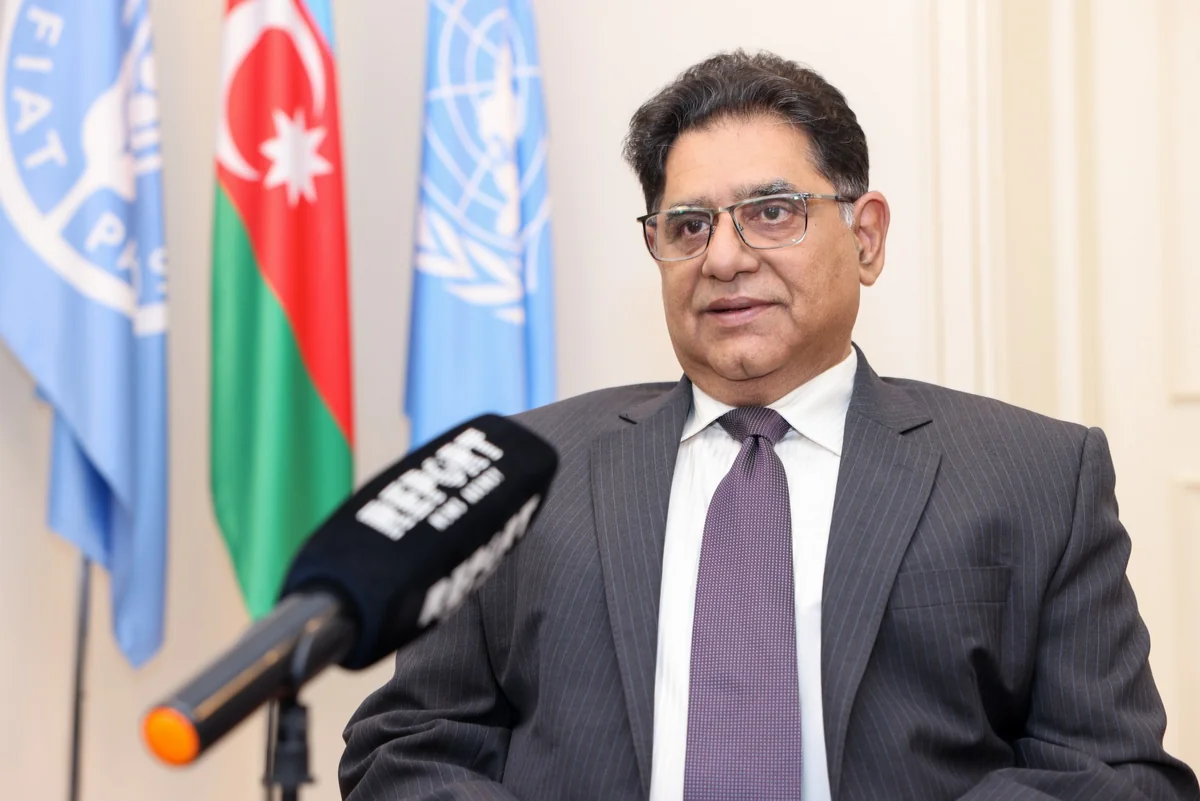
In an interview with Report, the FAO Representative in Azerbaijan and Head of the FAO Partnership and Liaison Office, Nasar Hayat, touched upon important issues, including the current state of cooperation and priorities for the upcoming period. We present the interview:
- What priority projects are currently being implemented under the Country Programming Framework document, which determines the main areas of cooperation between FAO and the Government of Azerbaijan, and what are their main results?
- FAO's activities in Azerbaijan are multifaceted and are not limited solely to the projects we implement with the government. Thus, our activities cover issues ranging from local communities to national, regional, and global levels. When reviewing this broad framework of agricultural and food support, we divide it among individual countries. This is exactly when the Country Partnership Framework comes into play. Furthermore, FAO has a Global Strategic Framework. However, how this strategic framework is realized in Azerbaijan is an integral part of the Country Programming Framework. This depends on two main factors: what does the country need? what are the government's priorities? As for Azerbaijan, we have very close cooperation with the Ministry of Agriculture. The country's national needs and FAO's technical recommendations are fully aligned with each other.
Currently, we are working on a number of priority areas in Azerbaijan. For example, we are implementing projects aimed at improving soil quality, protecting biodiversity, applying biological control methods in plant protection, developing digital agriculture, bringing soil laboratories in line with international standards, adapting to climate change, as well as strengthening the capacity of rural communities.
- How important is it to increase the interest of young people in this field for the future of Azerbaijan's agricultural sector? What are the main socio-economic barriers currently preventing young people from being involved in this sector?
- The involvement of young people in agriculture is an extremely important issue not only for Azerbaijan, but for any country. Currently, the majority of people engaged in agriculture are representatives of the older generation. But who will engage in agriculture after this older generation? We must pay close attention to keeping agriculture and the food system intact and passing them on to future generations.
The situation regarding the agricultural sector in Azerbaijan is very interesting. More than 22% of the population are young people aged 14-29. But the number of young people engaged in agriculture in the country is decreasing. There are several reasons for this. Currently, Azerbaijan hosts 900,000 family farms. Because the standard of living, job opportunities, and quality of life in cities are incomparably higher, the vast majority of the younger generation prefers to move to cities.
So, what needs to be done to keep young people in rural areas in the future? For this, first of all, the agricultural sector must be more profitable. If there is more money in agriculture, people will stay in the villages and engage in this field. Currently, many young people consider technology and city life to be more promising and comfortable. However, we must convey the message to young people that this comfortable life and earning money are also possible in agriculture.
The second challenge is more sociological. Because many young people have seen how their grandfathers engaged in agriculture. The agriculture of their grandfathers was physically demanding, and old methods and old technologies were used. Therefore, young people do not want to engage in this field. However, agriculture has changed in recent years. It no longer consists solely of digging the soil and sowing seeds. Of course, I am not saying that this is not important. Plowing the soil, preparing the field, sowing the seeds, watering them, etc., are very important. But nowadays, agriculture already means using sensors, artificial intelligence, drones, and satellite imagery.
- How can digitalization in agriculture change the daily activities of Azerbaijani farmers? In your opinion, is the biggest obstacle in the transition to digital agriculture related to the accessibility of technologies, or the digital literacy of farmers?
- I believe that the implementation of changes in the agricultural sector is a gradual process. Farmers rely on experience formed over many years. They learned how to cultivate the land from their parents and grandparents, and they trust this knowledge. Therefore, the application of new technologies requires time, trust, and the demonstration of their practical advantages. This is one of the biggest challenges I see in the agricultural sector when using digital technologies. This does not only apply to Azerbaijan. We encounter a similar situation in many countries. On the other hand, farmers are very smart people. Therefore, they look for ways to solve their problems. Problems in the agricultural sector can be solved through digital innovations.
Digitalization in agriculture means facilitating the work of farmers and increasing productivity by using artificial intelligence. This approach provides farmers with the opportunity to obtain important information about the treatment of plant and animal diseases, market prices, affordable resources, as well as accurate weather forecasts. The main goal is to deliver all this complex information to farmers through the simplest, most convenient, and understandable digital solutions.
Internet and mobile services are widely used in Azerbaijani society. Almost every one of us has a phone, a smartphone. Thus, we must explain to farmers how they can use this smartphone as a tool for digital agriculture.
- Currently, one of the main challenges related to agriculture is associated with water scarcity and the efficient management of water resources. How critical are these issues for the future of Azerbaijan's crop production sector?
- Of course, water resources are of vital importance for agriculture. Globally, approximately 70% of freshwater resources are used for agricultural purposes. In Azerbaijan, water scarcity is becoming an increasingly major challenge. First, Azerbaijan is a downstream country for all rivers. The majority of freshwater in Azerbaijan is formed by rivers flowing from neighboring countries. Therefore, it must be determined how water can be used efficiently. Efficient irrigation systems exist in some rural communities outside Baku. When speaking of a highly efficient irrigation system, I mean drip irrigation, sprinkler irrigation, and other similar methods that reduce water loss. Thus, without water resources, we will not be able to produce the food we need. Water is exactly this critical for Azerbaijan's agricultural sector. We must make the best use of the water we already have. We should not over-irrigate, and we should not allow the water to evaporate under the sun. I think that currently, Azerbaijan is doing very good work towards expanding modern irrigation means among farmers and farming communities. As water scarcity becomes a greater challenge in the future, Azerbaijan will be ready to combat it by using science, technology, and highly efficient irrigation systems.
- In which area could the greatest transformation occur in Azerbaijan's agriculture over the next 5-10 years - digitalization, climate adaptation, agro-processing, exports, or the social development of rural areas?
- We cannot work on adapting to climate change without using digital technologies. We cannot increase agricultural incomes or profits without developing the socio-economic aspects of rural communities. Therefore, for me, all these areas are important and none is superior to the other. On the contrary, they complement each other. In my opinion, the most important thing Azerbaijan's agricultural sector can do in the next 5–10 years is to adapt more to climate change by using digital technology and innovations. This, in turn, will contribute to improving the socio-economic conditions of rural communities. In other words, all of these are closely interconnected, and it is very difficult to separate one from the other.
- What new opportunities can the Smart Village concept create to retain young people in rural areas and ensure their employment? In which regions of Azerbaijan can this model be applied more successfully?
- I think the concepts of smart village and youth are closely related to each other. I am very glad that our youth are smart. But you know, when we talk about smart villages, we mean the use of technology in managing all natural resources within a community or village. The use of technology is not limited to communication alone. It also encompasses checking the soil, its moisture, determining when and what opportunities exist for irrigation, and other such issues. We implemented a pilot project in the village of Aghali in the Karabakh region, and it was very successful. We worked with a number of farming communities there to introduce the concept. This is currently possible anywhere in Azerbaijan. I think the Karabakh and Eastern Zangazur regions have a higher potential in this regard and are regions that are becoming a part of the country's agricultural system. However, I wouldn't say that this is impossible in other parts of the country. That is, as long as we have the right tools, resources, and the willingness of the people, we can do this anywhere with any community. The first issue is to bring people together.
- Can digital technologies and AgTech turn agriculture into a more attractive business field? What new professional and business opportunities do artificial intelligence, drones, sensors, and automated systems create here?
- If we want to make the most efficient use of our resources, we must use digital technologies: land, water, and other tools alike. We want to use these resources in the best possible way to maximize our profit in a more sustainable manner. We need to gain more profit without harming the environment and without damaging the soil. This is exactly where the main role of digital technology lies. Currently, we do not know which part of the farm is overwatered and which part is underwatered, or in which area there is a shortage of nitrogen, potassium, or calcium. Of course, there are ways to determine this, but it is a very complex process and takes a lot of time. With digital technology, however, we can determine this very quickly. All these Large Language Models (LLMs) are being increasingly trained on activities related to agriculture and the agrarian sector. Now you can order food from any restaurant in the city using your mobile phone. But when I was young, we didn't have such an opportunity or choice. Look, we can create a digital market for farmers in exactly this way. For example, with this, they would know exactly what the exact price of 1 kilogram of tomatoes is. These days, tomatoes are sold very cheaply when sold directly from the fields. I am very saddened by this. Because I believe that the production cost is higher than this price. So who loses money in this case? The farmer, of course. By using digital technologies, we can create a "win-win" situation that is beneficial for everyone. This approach means a sustainable future for everyone, including the youth in Azerbaijan. That is why we are focusing our attention more on the younger generation. Many young people do not see agriculture as a modern profession. Because they have seen how their grandfathers were engaged in agriculture. Today they do not know what agriculture means. I try to explain to young people and students that this is no longer the agriculture of your grandfathers' and great-grandfathers' era. This is completely different from 70 or 100 years ago. This is 21st-century agriculture.
Author

Photo